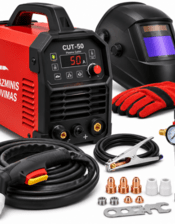
Plasma cutting uses an electric arc and a high-velocity gas stream to create a hot plasma jet capable of cutting electrically conductive metals. Plasma cutting machines are used for mild steel, stainless steel, aluminium and other suitable materials in fabrication, automotive repair, workshops and industrial applications.
The Irankistai.lt category includes plasma cutting machines, plasma torches and replacement consumables. Active cutter models include KRAFT&DELE KD1848 and KD3424, Sherman CUTTER 50 and CUTTER 70, PULI CUT60L and CUT80A, and YOULI YLCUT60. Input voltage, cutting current, compressed-air requirements and supplied accessories vary by model.
Always verify torch model, part dimensions and manufacturer compatibility information. Similar-looking parts are not necessarily interchangeable.
230 V plasma cutters can be suitable for workshops with an adequate single-phase supply. For example, the catalogue lists Sherman CUTTER 50 at 45 A with a 200 l/min air requirement. Three-phase 380–400 V cutters may suit more demanding workloads: Sherman CUTTER 70 is listed at 65 A, while PULI CUT80A offers a 20–80 A current range. Input voltage alone does not determine cutting performance.
Cutting capacity depends on current, material, air supply, torch condition and travel speed. The catalogue declares maximum cutting thicknesses of up to 25 mm for KRAFT&DELE KD3424, 23 mm for Sherman CUTTER 70 and 30 mm for PULI CUT80A. These are model-specific catalogue claims, not guarantees of identical clean-cut performance under all conditions.
Many air plasma cutters require an external compressed-air supply. The compressor must deliver adequate pressure and airflow continuously during cutting. Moisture, oil and other contaminants can reduce cutting quality and shorten consumable life. Follow the specific machine's air filtration and preparation requirements.
Plasma torches use replaceable electrodes, nozzles, protective caps and related components. Worn consumables can reduce arc stability and edge quality. When purchasing CB-50, PT-31, AG-60 / SG-55, A-141 or A-101 parts, confirm the exact torch system and component compatibility.
Plasma cutting is useful for shaped cuts in electrically conductive metal, but requires electrical power and, depending on the machine, compressed air. An angle grinder with a suitable disc may be more practical for simple short cuts. The right method depends on material, cut geometry, workload and working conditions.
Plasma cutting produces intense light, hot metal particles, fumes and noise. Use suitable eye, face, hand and body protection and effective fume extraction. Keep combustible materials away, inspect electrical connections and check the compressed-air system. Follow manufacturer instructions and assess hazards before cutting unknown or contaminated materials.
Yes. Plasma cutting can process electrically conductive aluminium when the machine and settings suit the material thickness and working conditions.
Many air plasma cutting machines require a compressed-air source with adequate pressure and flow. Always check the specific model requirements.
It can be, provided the electrical supply, cutting current, duty cycle and air system meet the intended workload.
It is a manufacturer-declared limit under specified conditions and may differ from the recommended thickness for fast, clean production cuts.
Not automatically. Parts must be matched to the exact torch design and manufacturer compatibility specifications.
Yes. Suitable plasma cutters can cut stainless steel, with results depending on material thickness and machine settings.