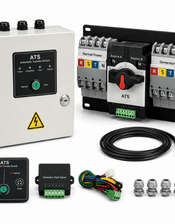
An Automatic Transfer Switch (ATS) is a system designed to automatically transfer the electrical load from the main power supply to a backup power source, usually a generator, when the main electricity supply fails or its parameters become unsuitable.
ATS commonly stands for Automatic Transfer Switch. When used with a compatible generator and automatic start control system, an ATS can not only transfer the load but also automatically start the generator when a power outage occurs.
A typical ATS system operates as follows:
With a correctly designed ATS system, the user does not need to manually start the generator during a power outage.
An ATS performs the important function of transferring the electrical load between different power sources.
A correctly installed system must ensure that the generator and the public electricity grid are not improperly connected to each other.
This is extremely important for the safety of:
A generator should therefore not simply be connected to a building's electrical installation through a standard wall socket.
A fixed generator and ATS installation should be designed and connected by a qualified electrician.
No.
This is one of the most important considerations when choosing an ATS.
The generator must be technically designed for automatic starting and have a suitable control connection or another ATS interface specified by the manufacturer.
Simply having an electric starter does not necessarily mean that the generator supports ATS operation.
An electric starter may only mean that the generator can be started using a key or button.
For automatic operation, the generator's control system must be capable of receiving the required ATS start and stop commands.
Therefore, generator and ATS compatibility must always be checked before purchase.
The ATS must match the electrical system of the building and the generator.
A single-phase ATS is used for 230 V single-phase electrical systems and compatible single-phase generators.
It may be suitable for:
A three-phase ATS is used for three-phase electrical systems and compatible three-phase generators.
It may be required for:
However, choosing between 230 V and 400 V is only part of the process.
You should also consider:
ATS systems are particularly useful where power interruptions can cause significant inconvenience, disruption or financial loss.
Common applications include:
For example, if electricity fails at a holiday property while the owner is away, a properly designed ATS system can automatically start the generator and restore backup power without requiring anyone to be physically present.
An ATS with a generator and a UPS are different backup power solutions.
An ATS combined with a compatible generator is particularly suitable for longer backup power requirements.
The generator can continue producing electricity as long as sufficient fuel is available and its operating requirements are met.
However, generator start-up and load transfer are not normally instantaneous.
The system needs time to:
This means there will normally be a short interruption in the electricity supply.
A UPS uses energy stored in batteries and can provide very fast or uninterrupted backup power, depending on the UPS technology.
It is commonly used for equipment that should not switch off even for a short period, such as:
Yes.
For systems where both immediate backup and long operating time are required, a UPS and generator with ATS can be combined.
A simplified system may operate as follows:
Mains electricity → UPS → critical equipment
When mains electricity fails:
UPS immediately supports the equipment → ATS starts the generator → generator stabilizes → system transfers to generator power.
The UPS therefore bridges the period between the mains power failure and the generator becoming ready to supply electricity.
This type of system can be useful for:
The exact system design and equipment compatibility should be evaluated by a qualified specialist.
Before purchasing an ATS system, check the following:
Generator ATS compatibility
→ The generator must support automatic start and stop control.
230 V or 400 V system
→ The ATS must match the electrical system and generator.
Rated current
→ The ATS must be suitable for the expected electrical load.
Number of poles
→ Must correspond to the electrical system design and switching requirements.
Generator control interface
→ The ATS and generator must be able to communicate using compatible control signals or connections.
Neutral switching requirements
→ These depend on the electrical system and installation design.
Transfer time and delays
→ ATS systems may use configurable delays before generator start or load transfer.
Electrical protection
→ The ATS does not replace all other electrical protection devices required by the installation.
Installation requirements
→ The ATS should be correctly integrated into the electrical distribution system by a qualified electrician.
Under normal conditions:
Electrical grid → Building
The generator remains switched off.
When mains electricity fails:
Mains failure → ATS detects the failure → Generator starts → Generator stabilizes → ATS transfers the load → Generator supplies the building or selected circuits
When mains electricity returns:
ATS detects stable mains power → Load transfers back to the grid → Generator runs briefly without load if required → Generator stops
The exact sequence and timing depend on the ATS controller, generator and system configuration.
Not necessarily.
This is an important distinction.
An ATS can automate the transition from mains electricity to generator power, but starting a generator takes time.
Depending on the system, there may be a power interruption lasting several seconds or longer before backup power becomes available.
If connected equipment must operate without interruption, an appropriate UPS may also be required.
An Automatic Transfer Switch (ATS) is designed to automatically transfer an electrical system from the main electricity supply to a backup power source when mains power fails.
When used with a compatible automatic-start generator, the system can detect a power outage, start the generator, wait for its output to stabilize and then transfer the electrical load to generator power.
When mains electricity returns, the ATS can transfer the load back to the grid and allow the generator to shut down automatically.
However, not every generator is compatible with an ATS. Having an electric starter alone does not necessarily mean that automatic start functionality is supported.
When choosing an ATS, it is important to consider the generator's control interface, 230 V or 400 V system, rated current, number of poles, electrical protection and the design of the building's electrical installation.
Fixed generator and ATS systems should be designed and connected by a qualified electrician.