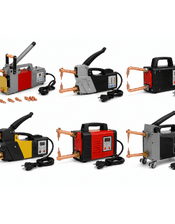
Spot welding machines are designed to join metal sheets through resistance welding using electrode pressure and electrical current. The Irankistai.lt range includes spot welding machines, replacement electrode tips and electrode holders. This equipment is used in suitable metalworking, sheet metal repair and workshop applications according to each manufacturer's intended purpose.
Types of spot welding machines and accessories
- Resistance spot welding machines. Listed models include LOTA Industries 979145 (declared 3 kW power), LOTA 979144 (6300–8900 A output current) and DN120T (declared 8 kW power). Technical specifications and operating modes vary by model.
- Round electrode tips. SSNAP and 979158 are supplied in packs of two. SSNAP is specified as copper in the catalogue.
- Pointed electrode tips. SSharp and 979157 are supplied in packs of two. SSharp is listed as copper.
- Electrode holders. LOTA ARM260 consists of two 260 mm holders. Electrodes are not included.
How to choose a spot welding machine
- Sheet thickness. Check the manufacturer's permitted sheet thickness and combinations. LOTA 979145 is listed for 0.5+0.5 to 1.5+1.5 mm, while DN120T is listed for 0.6+0.6 to 2.0+2.0 mm.
- Welding current and power. Manufacturers provide different specifications. Consider these together with sheet thickness, electrode force and duty cycle rather than relying on a single number.
- Electrical requirements. Verify supply voltage, frequency, input current and the suitability of the electrical installation. DN120T, for example, is listed for 230 V, 50 Hz.
- Duty cycle. Consider the working and cooling intervals specified by the manufacturer. DN120T is listed with a 30% duty cycle and LOTA 979144 with 10%, although direct comparison depends on test conditions.
- Electrodes and holders. Choose accessories based on the machine's mounting design and required working shape. Round and pointed tips are not automatically interchangeable between all machines.
- Package contents. Check whether the required electrodes, tips and holders are included. DN120T is listed with four supplied electrodes.
How does resistance spot welding work?
During resistance spot welding, metal sheets are compressed between electrodes and a high electrical current passes through the joint for a short period. Heat generated by electrical resistance forms a welded joint. Results depend on the metal type and thickness, electrode condition, pressure, current and welding time.
Before operation, verify the suitability of the metal, surface preparation, electrode condition and machine settings. Follow the manufacturer's duty cycle limits and electrical safety instructions, and use appropriate protective equipment.
Frequently asked questions
What is the difference between a spot welding machine and a body repair spotter?
A resistance spot welding machine joins sheets using electrode pressure and current. A body repair spotter is generally used to attach pulling elements to sheet metal for dent removal. Actual functions depend on the specific model.
Can a spot welder join two 2 mm sheets?
It depends on the machine and material. For example, DN120T is listed with a two-sheet thickness range up to 2.0+2.0 mm. Always check the manufacturer's operating conditions.
Do all electrode tips fit every spot welder?
No. Electrode tip and holder compatibility depends on mounting dimensions, construction and the machine manufacturer's requirements.
Are electrodes included with LOTA ARM260 holders?
No. The catalogue specifies two 260 mm holders, with electrodes sold separately.