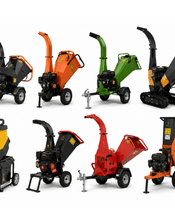
A wood chipper or garden shredder helps process branches and other woody garden waste left after pruning trees, shrubs and hedges. Shredded material takes up less space, is easier to transport and compost, and can also be used as mulch.
When choosing a wood chipper or garden shredder, the most important factors to consider are the diameter and quantity of branches, engine or motor type and power, shredding mechanism and expected workload.
Electric garden shredders are best suited for use around the home, garden or smaller property. They are generally more compact, quieter and require less maintenance than petrol-powered machines.
An electric shredder is a good choice when:
Petrol wood chippers are designed for higher productivity and provide complete mobility. They are better suited for larger properties, orchards, farms and more demanding applications.
A petrol model is worth considering when you need to process larger quantities of material, thicker branches or work in areas without access to mains electricity.
One of the most important specifications is the manufacturer's stated maximum branch diameter.
For hedge trimmings, shrubs and smaller young tree branches, a lower-capacity shredder is usually sufficient.
Thicker branches from fruit trees and other mature trees require a machine with greater cutting capacity.
Keep in mind that the maximum stated diameter generally represents the machine's technical limit under suitable conditions. Hard, dry or heavily branched wood may be more difficult to process than a fresh, straight branch of the same diameter.
If you regularly plan to chip branches around 40–50 mm in diameter, choosing a machine with some additional capacity is therefore advisable.
Different wood chippers and garden shredders use different cutting systems.
Blade shredders use high-speed rotating blades to cut the material. This system is well suited for fresh branches, shrub cuttings and other garden waste.
Roller or milling shredders pull branches into the machine and crush them. These machines generally operate at lower speeds and are particularly suitable for woody branches.
Disc or drum chipping systems are more commonly found in powerful petrol machines. They are designed to process larger quantities of material and handle more demanding workloads.
When comparing machines, consider not only motor or engine power but also the type of cutting or shredding mechanism used.
Electric shredder power is generally specified in watts (W), while petrol engine output may be specified in kW or HP.
Higher power can help the machine handle heavier loads, but power alone should not determine your choice.
It is more useful to consider the combination of:
If you only need to process a few piles of branches after seasonal pruning, a smaller electric shredder will usually be the more practical option.
If you regularly maintain a large garden or need to process a significant amount of material in a short period of time, shredding capacity and feed opening size become more important.
A larger feed opening makes it easier to insert branched material and can reduce the amount of preparation and trimming required before feeding branches into the machine.
Some shredders automatically pull branches into the cutting mechanism. This reduces the need to continuously push material into the machine and makes operation more convenient.
A reverse function can also be useful. If a branch becomes jammed in the shredding mechanism, reversing its direction can make it easier to release the blockage.
These features are particularly valuable when the machine is used regularly.
Compact electric shredders may feature an integrated or removable collection container for shredded material.
This is convenient for smaller gardens because the chips are collected immediately, helping to keep the working area cleaner.
More powerful petrol wood chippers often use a discharge chute, which directs the processed material into a pile, bag, container or trailer.
Wood chippers and shredders can be relatively heavy, so it is worth considering the chassis design, wheel size and overall machine weight.
Smaller electric models are convenient when the shredder needs to be moved frequently around the house or garden.
For larger petrol-powered machines, strong and larger wheels are particularly useful when transporting the machine across uneven garden or property surfaces.
For a small garden and seasonal pruning – a compact electric garden shredder is usually a practical choice.
For thinner, fresh branches and shrub cuttings – consider a blade-type shredder.
For larger quantities of woody branches – choose a higher-capacity machine designed for regular use.
For a large garden or property – a petrol wood chipper provides greater mobility and productivity.
For thicker branches and demanding applications – consider a professional-grade petrol wood chipper with a powerful cutting system and sufficient reserve in maximum branch diameter.
When choosing a wood chipper or garden shredder, first determine the diameter and quantity of branches you will most frequently need to process. Then compare engine or motor power, shredding mechanism and additional features. In practice, choosing the correct branch capacity and cutting system is more important than simply selecting the machine with the highest power rating.