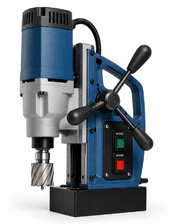
Magnetic drill presses are designed for accurate drilling in steel structures, beams, profiles, plates and other metal workpieces. The magnetic base allows the machine to be securely attached directly to a ferromagnetic surface, making magnetic drills particularly useful for construction, steel fabrication, installation and repair work.
When choosing a magnetic drill press, the most important factors to consider are the required drilling diameter, type of drill bits or annular cutters, motor power, spindle speed range and magnetic holding force.
One of the main factors when choosing a magnetic drill is its maximum drilling capacity.
Up to Ø28–30 mm – a good choice for installation and general steel construction work where large-diameter holes are not required. More compact machines are also easier to transport between job sites.
Up to Ø35 mm – a versatile option for professional applications. The increased drilling capacity provides greater flexibility when working with different steel structures and profiles.
Up to Ø50 mm – suitable for larger holes and more demanding metalworking applications. These machines are a better choice when larger annular cutters are used regularly.
It is not always necessary to choose the largest machine. If most of your work involves holes up to approximately 30 mm, a smaller and lighter magnetic drill may be more practical.
Magnetic drill presses are commonly used with annular cutters. Unlike conventional drill bits, an annular cutter removes material only around the circumference of the hole rather than cutting through the entire area.
This makes annular cutters particularly efficient for producing larger-diameter holes in steel.
Twist drill bits are convenient for smaller holes and general drilling applications.
Annular cutters are particularly suitable for larger holes in steel structures, beams, profiles and plates.
When choosing a magnetic drill, pay attention to its tool mounting system.
19 mm Weldon – a widely used mounting system for annular cutters and a common choice for professional metal drilling.
Morse MT2 – a tapered tool mounting system that provides additional flexibility for using different drilling tools and adapters.
If the machine will mainly be used with annular cutters, always check that the cutter shank is compatible with the magnetic drill.
Magnetic drill presses are available with different motor power ratings, from compact machines for lighter work to more powerful models designed for demanding professional applications.
However, a higher wattage does not automatically mean that a particular machine is the best choice.
Motor power should be considered together with:
For regular use with larger annular cutters, choosing a machine with sufficient power reserve is recommended.
The correct spindle speed depends on the diameter of the cutting tool and the material being drilled.
As a general rule, larger annular cutters and drill bits require lower spindle speeds. Smaller cutting tools can usually operate at higher speeds.
If you plan to drill holes of different diameters, consider a magnetic drill with adjustable speed or multiple mechanical speed settings.
This makes it easier to adapt the machine to different drilling applications.
The magnetic base must securely hold the machine against the steel surface during drilling.
The effectiveness of the magnet depends not only on its specified holding force but also on the condition and properties of the workpiece. Factors that can reduce magnetic holding performance include:
Before drilling, make sure the magnetic base has sufficient contact with a clean and suitable ferromagnetic surface.
When drilling thicker steel structures, maximum hole diameter is not the only specification to consider.
You should also check the maximum cutting depth, machine travel and working length of the annular cutter.
This is particularly important when drilling thicker steel plates, beams and other heavy structural components.
For general installation work and holes up to approximately Ø30 mm – choose a compact Ø28–30 mm class magnetic drill press.
For versatile professional applications – an Ø35 mm class machine provides greater drilling capacity while remaining relatively compact and portable.
For larger-diameter holes – choose an Ø50 mm class magnetic drill designed for larger annular cutters.
If you mainly use annular cutters – look for models with a 19 mm Weldon mounting system.
If you require a more versatile tool mounting system – consider a model with a Morse MT2 taper and Weldon adapter.
When choosing a magnetic drill press, do not base your decision solely on motor power. First determine the maximum diameter and depth of the holes you need to drill and the type of cutting tools you plan to use. This will make it much easier to select the appropriate drilling capacity, motor power and tool mounting system.