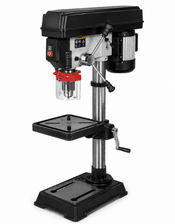
A drill press is designed for accurate and stable drilling in wood, metal, plastic and other materials. Compared with a handheld drill, a drill press provides better control over the drilling angle, depth and workpiece position, making it particularly suitable for workshops, metalworking, woodworking and repetitive drilling tasks.
When choosing a drill press, the most important factors to consider are motor power, drilling capacity, chuck capacity, spindle travel, speed adjustment and overall machine size.
Benchtop drill presses are compact and designed to be mounted on a workbench. They are well suited for smaller workshops, DIY applications and work with small to medium-sized workpieces.
Floor-standing drill presses feature a taller column and are installed directly on the floor. The increased distance between the chuck and base makes it easier to work with larger workpieces. These machines are often preferred for professional workshops and more demanding applications.
Motor power affects the machine's ability to work with different drill bit sizes and harder materials.
For light-duty drilling in wood, plastic or thin metal, a lower-powered drill press may be sufficient. For regular metal drilling, larger drill bits or more intensive use, a more powerful model is generally preferable.
However, motor power alone does not determine drilling performance. It should be considered together with spindle speed, torque and the manufacturer's specified maximum drilling capacity.
Different materials and drill bit diameters require different spindle speeds.
Smaller drill bits generally require higher speeds, while larger drill bits and metal drilling often require lower spindle speeds.
For versatile use, it is therefore worth choosing a drill press with multiple speed settings or adjustable spindle speed.
If you frequently work with different materials and drill bit sizes, variable electronic speed control can be particularly convenient, allowing the speed to be adjusted without repositioning drive belts.
Chuck capacity indicates the range of drill bit shank diameters that can be held by the machine.
For example, a 1.5–13 mm chuck is suitable for many general drilling tasks, while a 1–16 mm chuck or a similar range provides greater flexibility for using larger drill bits.
However, the maximum chuck capacity does not necessarily mean that the machine can efficiently drill a hole of the same diameter in every material. Always check the manufacturer's specified maximum drilling capacity.
Spindle travel indicates how far the drill bit can move downwards without repositioning the workpiece.
Greater spindle travel makes it easier to drill deeper holes and thicker workpieces.
For light-duty applications, very long spindle travel may not be necessary. However, for a versatile workshop drill press, it is an important specification to compare.
This specification helps determine the maximum size of workpiece that can be positioned conveniently under the drill bit.
The greater the distance between the centre of the spindle and the machine column, the further from the edge of a workpiece a hole can be drilled.
When working with larger panels or workpieces, a larger drill press may therefore be more suitable.
A strong and adjustable work table makes positioning the workpiece easier and more accurate.
Useful table adjustment features include:
When drilling metal, securing the workpiece properly is particularly important. For this reason, consider the table design and whether a suitable drill press vice or clamps can be used.
If you need to drill multiple holes to the same depth, a drilling depth stop is a particularly useful feature.
Once the required depth is set, identical holes can be drilled repeatedly, making this feature valuable for repetitive and production-type work.
Depending on the model, drill presses may include additional features such as:
These features do not necessarily determine the drilling capacity of the machine, but they can significantly improve convenience and ease of use.
For light DIY and hobby work – a compact benchtop drill press with a 13 mm chuck and several speed settings is usually sufficient.
For a versatile workshop – consider a more powerful benchtop drill press with a 16 mm chuck, greater spindle travel and a wide spindle speed range.
For regular metal drilling – low spindle speeds, sufficient torque, rigid construction and secure workpiece clamping are particularly important.
For larger workpieces – consider a larger benchtop or floor-standing drill press with greater spindle-to-column distance and increased working height.
When frequently changing drill bit sizes and materials – a drill press with electronic or continuously variable speed control can make work considerably more convenient.
When choosing a drill press, do not base your decision solely on motor power. First compare the maximum drilling capacity, spindle speed range, chuck capacity, spindle travel and working dimensions. These specifications provide a much better indication of whether a particular drill press is suitable for the work you intend to perform.