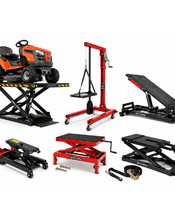
A garden machinery lift is a practical tool designed for lifting lawn tractors, ride-on mowers, lawn mowers and other wheeled garden machinery during maintenance, cleaning or repair work. Raising the machine makes it easier to access the cutting deck, blades, belts, wheels and other components located underneath.
When choosing a lift, it is important to consider not only its lifting capacity, but also the lifting method, machine design, wheel arrangement and the type of maintenance work you plan to perform.
A lift is particularly useful for regular maintenance of lawn tractors and ride-on mowers. It can be used for:
It is especially convenient when the underside of the machine needs to be accessed several times during the season.
One of the most important factors is how the garden machine will be lifted. The most common options are front lifts and side lifts.
A front lift raises one end of a lawn tractor or ride-on mower, usually by supporting the front wheels.
This type of lift is convenient when you need to:
Front lifts can be mechanical or hydraulic. A hydraulic mechanism usually makes it easier to lift heavier machinery with less physical effort.
A side lift raises one side of the machine. This tilts the lawn tractor or mower and provides easier access to its underside.
This solution is particularly useful for:
Before choosing this type of lift, make sure that the design of your garden machinery allows it to be safely lifted from the side.
Every lift has a manufacturer-specified maximum lifting capacity, for example 135 kg, 340 kg or another stated weight.
It is important to understand that a lift will usually support only part of the total weight of the lawn tractor, rather than the entire machine. However, the maximum rated lifting capacity must never be exceeded.
It is recommended to choose a lift with sufficient capacity in reserve rather than selecting a model whose maximum load is very close to the actual load placed on the lifting point.
Example: if you have a heavier lawn tractor, choosing a higher-capacity lift is advisable even if a smaller model would theoretically be sufficient.
Lifting capacity alone does not guarantee that a lift will be compatible with your machine.
Before purchasing, check:
This is particularly important for larger lawn tractors and mowers with non-standard designs.
The higher the machine can be raised, the more working space is available underneath it. However, the highest possible lifting height is not always necessary.
If the lift will mainly be used for cleaning the cutting deck and maintaining the blades, the most important factor is having enough space to safely and comfortably access the required components.
A greater lifting range may be useful when carrying out more extensive maintenance or repair work.
Mechanical models generally have a simpler construction. The machine is raised by turning or operating a mechanical lifting mechanism.
Advantages:
A hydraulic lift uses a hydraulic mechanism to raise the machine.
Advantages:
If you regularly maintain garden machinery or own a heavier lawn tractor, a hydraulic model will often be the more convenient option.
Safety is one of the most important considerations when working with raised machinery.
Always use the lift on a firm, level and stable surface. Before lifting, make sure that the machine is correctly positioned on the lift supports and that the wheels cannot move unexpectedly.
Always follow the instructions provided by both the lift manufacturer and the garden machinery manufacturer.
Never exceed the manufacturer's specified maximum lifting capacity.
If any part of your body needs to be positioned underneath the raised machine during maintenance or repair work, never rely solely on the lifting mechanism. Use the mechanical locking system or additional approved safety supports specified by the manufacturer.
If the lift will mainly be used for cleaning the cutting deck and maintaining or replacing blades, a simpler mechanical model will usually be sufficient.
If you own a larger and heavier lawn tractor, consider a higher-capacity or hydraulic lift.
If your priority is easy access to the entire underside of the cutting deck, a side-lifting model may be the better choice.
If you maintain garden machinery frequently or professionally, a hydraulic lift can save time and reduce the physical effort required.
Before purchasing a garden machinery lift, check:
✓ Lift type – front or side lift
✓ Lifting capacity – whether it is sufficient for your machine
✓ Lift dimensions – whether they are compatible with the wheel arrangement
✓ Lifting height – whether there is enough working space
✓ Lifting mechanism – mechanical or hydraulic
✓ Safety locking system – how the machine is secured against accidental lowering
✓ Compatibility – whether the lift is suitable for your particular lawn tractor or mower
A properly selected lawn tractor or mower lift makes seasonal maintenance, cutting deck cleaning, blade replacement and other servicing tasks considerably easier and more convenient.
Sorry, but there are no products to list in this category.
