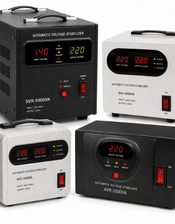
A voltage stabilizer is an electrical device designed to maintain a more suitable output voltage when the mains voltage fluctuates or becomes too high or too low. It can be used in homes, workshops, holiday properties, commercial premises and certain power supply systems incorporating generators.
A voltage stabilizer is particularly useful in locations where the electrical supply is unstable and frequent voltage drops or increases occur.
However, choosing the correct stabilizer is important. It is not enough simply to purchase, for example, a “5000 W voltage stabilizer”. You need to consider the input voltage range, power requirements of the connected equipment, starting currents, whether a 230 V or 400 V system is used, and the stabilizer technology.
The purpose of a voltage stabilizer is to correct fluctuations in the incoming voltage and maintain the output voltage within specified limits.
For example, mains voltage may occasionally decrease or increase. If the voltage remains within the stabilizer's supported input range, the device adjusts the output and provides a more stable voltage to the connected equipment.
This can be useful for:
A voltage stabilizer may be worth considering if you experience:
Before purchasing a stabilizer, however, it is advisable to measure the actual mains voltage or have the electrical system assessed by a qualified electrician.
If the problem is caused by faulty wiring, poor electrical connections, undersized cables or another electrical installation problem, a voltage stabilizer alone will not solve it.
Depending on the specific model, a voltage stabilizer can help reduce problems associated with:
Some models may also include:
The available protection features depend on the specific stabilizer, so always check the technical specifications.
It is important not to confuse a voltage stabilizer with a complete electrical protection system.
A voltage stabilizer does not replace:
A voltage stabilizer also does not generate backup electricity.
If equipment needs to continue operating during a complete power outage, you will need a UPS, battery backup power supply or generator.
This is one of the most important specifications.
First determine which equipment will be connected to the stabilizer.
If several appliances will be connected, calculate their combined simultaneous power consumption.
For example:
Simply adding these figures together may not always be sufficient because some equipment can require significantly higher current during start-up.
For this reason, a voltage stabilizer should be selected with a sufficient power reserve.
Particular attention should be paid to equipment containing electric motors and compressors.
Examples include:
For example, if a pump has a rated power of 1,000 W, this does not automatically mean that a 1,000 W stabilizer will be sufficient.
During start-up, the motor may require significantly higher current.
The stabilizer should therefore be selected according to both normal power consumption and the highest expected short-term loads.
Voltage stabilizer capacity may be specified not only in watts (W), but also in volt-amperes (VA) or kilovolt-amperes (kVA).
1,000 VA does not necessarily mean 1,000 W.
The actual active power available depends on the power factor of the connected load and the characteristics of the stabilizer.
Therefore, if a stabilizer is rated at, for example, 5 kVA, you should not automatically assume that a 5 kW load can be connected under all operating conditions.
Always check the manufacturer's specified active power capacity and operating conditions.
The power rating alone does not determine whether a stabilizer will solve a particular voltage problem.
One of the most important specifications is the operating input voltage range.
For example, if the voltage in your electrical network regularly drops to a very low level, the stabilizer must be designed to operate within that input range.
If the mains voltage falls outside the stabilizer's permitted limits, the unit may no longer be able to maintain the required output voltage or may disconnect the load for protection.
Before selecting a stabilizer, it is therefore useful to know:
What is the lowest voltage occurring in the network?
What is the highest voltage occurring in the network?
Only then can you determine whether the stabilizer's operating range is suitable.
This is an important but often overlooked consideration.
For some voltage stabilizers, the maximum advertised capacity is only available within a certain input voltage range.
When the input voltage drops significantly, the maximum permitted load of the stabilizer may also decrease.
Therefore, if the stabilizer is being purchased specifically because of very low mains voltage, check the manufacturer's power derating characteristics in relation to input voltage.
The correct choice depends on the electrical system.
Suitable for:
If you only need to stabilize one 230 V appliance or a single-phase circuit, a single-phase stabilizer will usually be sufficient.
Required when stabilizing a three-phase system or supplying 400 V three-phase equipment.
Examples include:
In a three-phase system, it is also important to consider load distribution between phases and the operating principle of the specific stabilizer.
Voltage stabilizers can be divided into several main types according to their regulation technology.
Relay stabilizers regulate voltage by switching between transformer winding steps.
Typical advantages include:
Because regulation is performed in steps, the output voltage is corrected incrementally rather than continuously.
Servo stabilizers use an electromechanical mechanism to regulate voltage.
Potential advantages include:
Because the system contains moving mechanical components, response speed and maintenance requirements may differ from electronic or relay-based solutions.
Electronic stabilizers use electronic components to control the output voltage.
Depending on their design, they may provide:
The actual characteristics should always be evaluated according to the technical specifications of the specific model.
Both options are possible.
This is a simpler solution when voltage problems mainly affect specific equipment.
For example:
In this situation, the stabilizer can be sized specifically according to the requirements of that appliance.
If voltage is unstable throughout the property, a higher-capacity stabilizer installed in the main electrical system may be considered.
In this case, you need to evaluate:
The selection and installation of such a system should be carried out by a qualified electrician.
It can be suitable if the heating equipment requires a more stable supply voltage and the selected stabilizer meets its technical requirements.
A heating system may contain:
The stabilizer should therefore be selected according to the total load of the connected heating system, not only the power consumption of the controller.
If the heating system must continue operating during a complete power outage, a stabilizer alone is not sufficient – a UPS, backup power supply or generator is required.
Yes, but it is particularly important to consider compressor starting current.
A refrigerator may have relatively low power consumption during normal operation, but its electrical demand temporarily increases when the compressor starts.
The stabilizer therefore needs sufficient reserve capacity to handle this starting load.
The same principle applies to air conditioners, heat pump components, compressors and other equipment containing electric motors.
In some systems, a voltage stabilizer may be used together with a generator, but this is not a universal solution for every generator.
First, determine what problem you are trying to solve.
If the generator's output voltage falls outside the stabilizer's permitted input range, or if unstable generator output is caused by incorrect operation, overload or a technical fault, adding an external stabilizer may not solve the underlying problem.
It is also important to distinguish between different technologies:
Generator AVR regulates the output voltage of the generator itself.
External voltage stabilizer is a separate device installed between the power source and the electrical load.
Inverter generator uses a different electronic power conversion technology.
If a stabilizer will be used with a generator, check the requirements of both manufacturers and ensure that the devices are compatible.
These are different types of equipment.
Its primary function is to:
correct low or high input voltage and stabilize the output within the capabilities of the device.
However, if the electricity supply fails completely, the stabilizer itself cannot provide backup power.
A UPS stores energy in batteries.
If mains electricity fails, it can continue supplying connected equipment for a certain period.
UPS systems are commonly used for:
Some UPS systems also include voltage regulation functions. It is therefore worth determining whether your application requires a stabilizer, a UPS or a combination of both.
These are also different devices.
A voltage stabilizer is intended to correct longer-lasting voltage deviations and fluctuations within its operating range.
Surge protection devices are designed for a different type of electrical protection, including short-duration transient overvoltages.
A comprehensive electrical protection system may therefore require several different types of protective equipment.
The most important criteria include:
Input voltage range – the minimum and maximum input voltage the stabilizer can accept.
Output voltage – the voltage the unit maintains and its regulation accuracy.
Capacity – specified in W, VA or kVA.
Available capacity at low input voltage – particularly important when significant voltage drops are the main problem.
Starting load capability – important for pumps, refrigerators, compressors and motors.
Single-phase or three-phase – for 230 V or 400 V systems.
Regulation technology – relay, servo or electronic.
Response speed – how quickly the stabilizer responds to voltage changes.
Regulation accuracy – the range within which output voltage is maintained.
Protection functions – overload, temperature, short-circuit and other protections available on the specific model.
Start-up delay – can be useful for refrigeration and other compressor-based equipment.
Mains voltage is frequently too low or too high
→ First measure the actual voltage range and select a stabilizer accordingly.
You want to protect a single appliance
→ Select the stabilizer according to the appliance's power requirements and starting current.
You want to stabilize the electricity supply for an entire house
→ A higher-capacity stabilizer is required, selected according to the property's electrical system and simultaneous load.
You only use 230 V equipment
→ A single-phase stabilizer will usually be required.
You have 400 V three-phase equipment
→ An appropriate three-phase stabilizer is required.
You use a pump, compressor or refrigerator
→ Always consider starting current requirements.
You need equipment to continue operating during a power outage
→ A stabilizer alone is not sufficient – you need a UPS, backup power source or generator.
You plan to use the stabilizer with a generator
→ Check the compatibility of the generator and stabilizer specifications and manufacturer requirements.
A voltage stabilizer is useful when an electrical network experiences longer-lasting low, high or fluctuating voltage conditions and more suitable supply conditions are required for connected equipment.
The stabilizer should not be selected solely according to the maximum power figure shown on the unit. You should consider the actual input voltage range, power requirements of the connected equipment, starting currents, whether the system is 230 V or 400 V, and the stabilizer's regulation technology.
For homes or individual appliances, single-phase 230 V stabilizers are most commonly used, while three-phase equipment and 400 V electrical systems require appropriate three-phase solutions.
It is also important to distinguish a voltage stabilizer from a UPS, surge protection device and generator. These devices perform different functions and, depending on the application, may be used together.