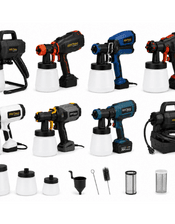
Electric and cordless paint sprayers are tools used to spray coatings onto fences, furniture, doors, wooden structures and various finishing surfaces. They can make it easier to coat complex shapes, adjust material delivery and, with suitable equipment, complete painting tasks faster than with a brush.
The Irankistai.lt range includes 230 V mains-powered electric paint sprayers and 18 V cordless spray guns. Important selection criteria include the painting area, nozzle size, paint cup capacity, coating viscosity, material flow rate and package contents.
An electric paint sprayer is powered from the mains and can be convenient for longer jobs where a power outlet is available. There is no battery charge to monitor, although the power cable restricts movement.
A cordless paint sprayer provides greater freedom of movement when painting fences, garage doors, wooden components and other surfaces where a cable would be inconvenient. Operating time depends on battery capacity, tool load and working conditions.
For either type, suitability depends not only on the power source but also on the spray system, nozzle and coating requirements.
The active category range includes several mains-powered models:
Manufacturers may measure performance under different conditions. Power in watts alone does not determine actual painting speed or finish quality.
YATO YT-82765 is an active 18 V cordless paint spray gun with a 2.2 mm nozzle, 1 L paint cup and a listed flow rate of up to 1 L/min. The model features paint flow and spray width adjustment, a battery charge indicator and battery cell overheating protection.
The Lithuanian product description lists a kit with a battery and charger, but different language specifications provide inconsistent battery capacities. Check the current package contents on the individual product page before ordering.
Other cordless models assigned to this category may currently be inactive and should not be treated as active offers.
Depending on the sprayer and coating properties, the equipment may be suitable for:
Not every sprayer can handle thick wall paints, primers or varnishes. Always check the coating manufacturer's recommended spraying equipment and material viscosity.
Nozzle diameter is one of the parameters affecting paint delivery and spray characteristics. The active category range includes models with 1.8, 2.2, 2.5 and 2.6 mm nozzles.
A smaller or larger nozzle does not automatically establish compatibility with a particular coating. Consider paint viscosity, permitted thinning, sprayer construction and the coating's technical data sheet. Perform a test spray before painting.
Paint sprayer specifications may list the maximum permitted material viscosity. For example, the SG041000 product page lists a maximum viscosity of 50 DIN. Such values must be interpreted according to the manufacturer's specified measurement method.
A DIN viscosity cup is used to measure the flow time of a coating according to a defined procedure. Paint that is too thick may spray poorly or block the nozzle. Thin coatings only as permitted by the paint manufacturer.
Prepare the surface, protect surrounding objects and verify coating compatibility before use. Perform a test spray, adjust material delivery and follow the manufacturer's recommended spraying distance.
After use, empty the cup and clean the nozzle and paint passages with compatible products. Disconnect mains power or remove the battery as instructed before cleaning.
Work in a suitably ventilated environment and use respiratory, eye and skin protection appropriate to the coating. Follow the coating's safety data sheet and the equipment manual.
Electric models are mains-powered, while cordless models operate without a power cable. Suitability also depends on spraying specifications.
It may be suitable if the sprayer and nozzle are compatible with the selected wall paint. Not all models are intended for thick coatings.
Follow the coating manufacturer's recommendations, viscosity requirements and sprayer specifications. Nozzle diameter alone is not sufficient.
These electric and cordless models have integrated spraying mechanisms, so a separate workshop air compressor is generally unnecessary.
It depends on the model and package contents. Check whether the battery and charger are included before purchase.
Follow the sprayer and coating manufacturers' instructions. Use a suitable viscosity cup if specified.
After use, clean the cup, nozzle and material passages according to the manufacturer's instructions, first safely disconnecting the power supply.