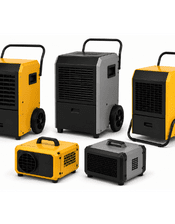
A construction dehumidifier is designed to reduce moisture levels and accelerate the drying of building materials. It can be used after plastering, painting, screeding and renovation work, as well as for water-damage restoration and drying rooms after leaks or flooding.
When choosing a construction dehumidifier, the most important factors are dehumidification capacity (L/24 h), room size, operating temperature, airflow and condensate drainage. For construction use, durability, mobility and suitability for continuous operation are also important.
One of the main specifications is the amount of water the unit can extract, normally expressed in litres per 24 hours (L/24 h).
The larger and wetter the space, the more capacity is generally required. However, room size alone is not enough to determine the correct unit. Temperature, initial relative humidity, moisture contained in building materials and air exchange also have a major impact on drying performance.
As a general guide:
For very large or divided spaces, using multiple dehumidifiers may provide more effective moisture removal.
Important: the manufacturer's rated L/24 h capacity is measured under specified temperature and humidity conditions. Actual water extraction on a construction site can therefore be considerably lower.
Most portable construction dehumidifiers use refrigerant condensation technology. Moist air passes over a cold heat exchanger, causing water vapour to condense.
These units are particularly effective in warm and humid environments. Their extraction performance generally decreases as room temperature falls.
They are suitable for:
Desiccant dehumidifiers use moisture-absorbing materials and are better suited to low-temperature environments or applications requiring very low relative humidity.
For this reason, a refrigerant dehumidifier may not always be the best solution for cold and unheated construction sites.
Operating temperature is one of the most important specifications when choosing a construction dehumidifier.
Refrigerant models perform best in warmer conditions. As temperatures decrease, less moisture can be condensed from the air and extraction performance drops. Professional construction units may therefore use an automatic defrost system to maintain operation at lower temperatures.
Always check the manufacturer's operating temperature range, not just the maximum L/24 h extraction figure.
Airflow is normally expressed in m³/h and indicates how much air can pass through the dehumidifier.
Higher airflow helps distribute dry air throughout the room and is particularly important on larger construction sites and when drying walls, floors and other building structures.
Drying can often be accelerated by combining the dehumidifier with air movers or construction fans, which improve airflow across wet surfaces.
Smaller dehumidifiers usually collect water in an integrated tank. On a wet construction site, this may require frequent emptying.
For intensive construction use, a model with continuous condensate drainage is usually more practical.
If gravity drainage is not possible, consider a model with an integrated condensate pump or the option to connect one.
An integrated humidistat allows the required relative humidity (% RH) to be selected. The dehumidifier can then regulate its operation according to the measured humidity.
This is particularly useful when the machine needs to operate for extended periods on a construction site.
When drying building materials, however, the lowest possible RH is not always the correct target. The required conditions depend on the material and the drying process.
For professional construction use, check:
For a small renovation or individual room, a smaller refrigerant dehumidifier may be sufficient.
For house construction, plaster, filler or floor drying, choose a professional higher-capacity unit with automatic defrost and continuous condensate drainage.
For large and heavily damp spaces, consider both extraction capacity and airflow. Multiple dehumidifiers combined with air movers may provide faster and more even drying.
For cold and unheated spaces, pay particular attention to the operating temperature. At very low temperatures, a desiccant dehumidifier may be the more suitable solution.
The best construction dehumidifier is therefore not simply the model with the highest L/24 h rating. It should be selected according to space size, actual temperature, moisture load, required drying speed and working conditions.