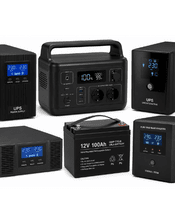
A UPS (Uninterruptible Power Supply) is a backup power device designed to maintain electricity supply to connected equipment when the mains power supply fails or becomes unstable.
A UPS contains a battery, allowing it to automatically provide backup power when mains electricity is lost. Depending on the UPS type, power rating and battery capacity, backup operation may last from a few minutes to several hours or longer.
UPS systems are most commonly used for computers and network equipment, but correctly selected models can also provide backup power for heating systems, circulation pumps, security systems, gate automation, servers, communication equipment and other devices sensitive to power interruptions.
When choosing a UPS, it is important to consider more than just its power rating. You should determine:
Under normal conditions, connected equipment is powered by the mains electricity supply, while the UPS monitors the power supply and, depending on its design, keeps its battery charged.
When mains power fails or its parameters fall outside the UPS operating limits, the UPS begins supplying energy stored in its battery.
An integrated inverter converts the battery's DC power into the 230 V AC power required by connected equipment.
A UPS can therefore help prevent the sudden:
UPS applications depend on the specific model and its technical specifications.
This is one of the most common applications for a UPS.
During a power outage, a UPS can provide enough time to:
A UPS can be used for:
Because these devices usually consume relatively little energy, a correctly sized UPS may be able to power them for a relatively long period.
UPS protection is particularly important for servers because even a short power interruption can disrupt system operation.
In professional environments, a UPS may also be integrated with automatic server shutdown and other power management systems.
A UPS can provide backup power for:
However, a UPS for a heating system must be selected carefully because some pumps and electric motors require not only sufficient power but also an appropriate 230 V AC waveform.
A UPS can provide backup power for:
Certain UPS systems can provide backup power for electric gates, garage doors and other automated systems.
In these applications, it is particularly important to consider the electric motor's starting current.
Both devices contain batteries and can provide electricity when mains power is unavailable, but their primary purposes are different.
A UPS is primarily designed for automatic backup power when the mains electricity supply fails.
Its main purpose is to prevent connected equipment from immediately shutting down or to provide sufficient time for a controlled shutdown.
A portable power station is primarily a mobile energy storage device.
It is useful for:
Some portable power stations include UPS or EPS functionality, but their transfer times and operating principles may differ from those of a dedicated UPS.
Therefore, not every portable power station should automatically be considered a full replacement for a UPS.
A UPS and a generator can both help during a power outage, but they work in completely different ways.
A UPS stores energy in a battery.
A generator produces electricity using petrol, diesel or another energy source.
The main advantage of a UPS is its ability to provide almost immediate or uninterrupted backup power, depending on its technology.
The main advantage of a generator is its ability to continue producing electricity for extended periods as long as fuel is available.
In larger backup power systems, a UPS and generator can be used together: the UPS supports the equipment immediately after a power failure, while the generator can later provide longer-term electricity.
The primary purpose of a voltage stabilizer is to correct excessively low or high mains voltage within its operating range.
A UPS contains stored energy in a battery and can continue powering equipment even when the mains electricity supply fails completely.
Some UPS systems also include AVR or other voltage regulation functions.
Therefore, in certain applications a UPS may also provide some voltage regulation, but the exact capabilities should always be checked in the technical specifications of the specific model.
UPS systems can generally be divided into three main technology categories.
This is a simpler type of UPS.
When the mains supply is operating normally, equipment is powered from the mains. When power fails, the UPS switches to battery operation.
These UPS systems are commonly used for:
They are an economical solution where advanced power conditioning is not required.
A Line-Interactive UPS can additionally correct certain mains voltage fluctuations without switching to battery operation for every minor voltage deviation.
These UPS systems are commonly used for:
This is one of the most versatile UPS technologies for home and small business applications.
An Online UPS supplies connected equipment through a continuous double-conversion system.
AC power is converted to DC and then converted back by the inverter to controlled AC output.
This type of UPS is used where power quality and continuity are particularly important.
For example:
Online UPS systems are generally more expensive and may have higher energy losses than simpler UPS technologies.
This is one of the most important concepts when choosing a UPS.
UPS capacity is often specified using two units:
VA – volt-amperes
and
W – watts.
For example, a UPS may be rated:
1000 VA / 600 W.
This means that the actual active load limit should be evaluated according to the manufacturer's specified W rating.
You should therefore never automatically assume:
1000 VA = 1000 W.
When selecting a UPS, always check both VA and W ratings.
First calculate the power consumption of all devices that will be connected to the UPS simultaneously.
For example:
Computer – 300 W
Monitor – 50 W
Router – 15 W
Total load:
365 W
In this case, you should not choose a UPS with a maximum active power rating of only 365 W.
A certain power reserve is recommended so that the UPS does not constantly operate at its maximum load and can respond properly to short-term changes in power demand.
If equipment containing an electric motor is connected to the UPS, its rated power alone may not be sufficient for sizing.
This applies to:
During start-up, these devices may temporarily require considerably more current than during normal operation.
The UPS inverter must be capable of handling this starting load.
Therefore, a 100 W pump does not necessarily mean that a UPS capable of supplying only slightly more than 100 W will be sufficient.
UPS runtime mainly depends on two factors:
battery energy capacity
and
connected load.
The larger the battery and the lower the load, the longer the UPS can operate.
However, actual runtime is also affected by:
For the most accurate estimate, use the runtime table or graph provided by the UPS manufacturer.
For a preliminary estimate, battery energy capacity can be calculated.
For example, with a:
12 V / 100 Ah battery
the theoretical energy capacity is:
12 V × 100 Ah = 1200 Wh.
If the connected load is:
100 W
the theoretical result would be:
1200 Wh ÷ 100 W = 12 hours.
However, in real-world conditions, the UPS will not operate for the full 12 hours.
Some energy is lost in the inverter, while the usable battery capacity depends on battery technology, discharge current, permitted depth of discharge and other conditions.
This calculation should therefore only be used as a preliminary comparison, not as a guaranteed runtime.
A UPS may use either an integrated or external battery system.
UPS systems with integrated batteries are compact and easy to use.
They are commonly designed for:
Some UPS systems or backup power inverters allow external batteries to be connected.
This makes it possible to significantly increase energy capacity and extend backup runtime.
Such solutions are particularly useful for:
However, battery voltage, technology and capacity must meet the requirements specified by the UPS manufacturer.
The 230 V AC output waveform of a UPS can vary depending on the model.
It may provide:
A Pure Sine Wave output is particularly worth considering when the UPS will power:
Always check the requirements of the equipment manufacturer before connecting a specific device.
For a heating system, first determine the total electrical demand.
Consider:
If the system includes electric motors, their starting current must also be considered.
For this application, it is often worth choosing a UPS with:
First calculate:
If the UPS is only required to provide enough time to save your work and safely shut down the computer during a power outage, a large battery capacity may not be necessary.
The more important factor is selecting a UPS with sufficient active power in watts (W).
Routers and other small network devices generally consume relatively little electricity.
Therefore, even a UPS with a relatively modest battery capacity may provide extended runtime.
However, consider the entire system:
Also remember that a local UPS cannot maintain an internet connection if the internet service provider's infrastructure stops operating during the power outage.
Yes. In certain systems, a UPS and generator can be used together.
For example:
Mains electricity → UPS → equipment
During a longer power outage, a generator may then provide the backup energy source.
However, the UPS must be compatible with the electrical output produced by the generator.
Some UPS systems can be sensitive to:
Before designing a combined UPS and generator system, check the technical requirements of both devices.
The most important specifications include:
UPS type
→ Offline, Line-Interactive or Online.
VA rating
→ overall UPS capacity specification.
Active power in W
→ particularly important when determining the actual connected load.
Battery capacity
→ has a major influence on backup runtime.
Integrated or external battery
→ important when longer backup operation is required.
230 V output waveform
→ Pure Sine Wave may be important for motors, pumps and sensitive equipment.
Starting load capability
→ essential for equipment containing motors.
Transfer time
→ particularly important for sensitive electronic equipment.
Charging current
→ important when larger external batteries are used.
Battery voltage
→ 12 V, 24 V, 48 V or another voltage depending on the system.
Protection functions
→ overload, short-circuit, excessive discharge, temperature and other protections depending on the model.
For a computer
→ Calculate the W consumption of the computer and monitor and choose a UPS with sufficient power reserve.
For a router and internet equipment
→ Focus on sufficient battery capacity for the required runtime.
For a heating boiler and circulation pump
→ Choose a UPS with sufficient output, consider starting current and, where required by the equipment, a Pure Sine Wave output.
For servers and important IT equipment
→ Consider a Line-Interactive or Online UPS depending on system requirements.
For long backup operation
→ Look for a UPS that supports appropriately sized external batteries.
For equipment with electric motors
→ Do not rely only on rated power – starting current must also be considered.
For use with a generator
→ Check the compatibility of the UPS input requirements and generator output characteristics.
A UPS is a backup power device designed to protect important electrical equipment from unexpected shutdowns and keep it operating for a certain period when mains electricity fails.
UPS systems can be used for computers, servers, internet and network equipment, heating systems, circulation pumps, security systems, gate automation and other important electrical equipment.
When choosing a UPS, do not focus only on the VA rating. You should also consider active power in W, starting current of connected equipment, required backup runtime, battery capacity and the 230 V AC output waveform.
If a UPS is only needed to provide enough time to safely shut down a computer, a smaller model with an integrated battery may be sufficient. If you need to operate a heating system, circulation pump or other important equipment for several hours, a higher-capacity UPS with support for an appropriately sized external battery may be a better choice.