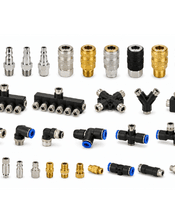
Pneumatic quick couplings and air distributors are used to connect compressed-air systems, compressors, paint spray guns and other pneumatic tools. They make it easier to change equipment, connect air hoses and distribute compressed air to several workstations or tools.
The Irankistai.lt range includes quick-connect plugs and sockets, internally and externally threaded fittings, Y-, T- and L-shaped connectors, 360° swivel fittings and multi-outlet air distributors. Important selection criteria include coupling profile, thread type, hose dimensions, permissible pressure and airflow capacity.
A quick-connect system normally consists of a compatible male plug and female coupler or socket. It allows pneumatic tools or hoses to be connected and disconnected quickly. Identical thread sizes do not necessarily mean that plugs and sockets from different manufacturers are compatible; their coupling profile and standard must also match.
The active range includes B1-E04, B2-E04, D1-F and D2-M models with 1/4-inch connections. The D1-F and D2-M product specifications mention a locking ring. Hose couplers A3-3/8, D3-5/16929 and D3-5/16 and the C3-8 brass plug are also available.
A female thread is located inside a fitting, while a male thread is on its outside. Pneumatic systems commonly use 1/4-inch threaded connections, but correct installation also requires checking the thread standard, sealing method and compatibility of the connected components.
Thread size should not be confused with hose internal diameter or the quick-connect plug profile. Mismatched connections can cause air leaks or prevent assembly.
An air distributor or manifold creates several connection points from one compressed-air supply. This is useful in automotive workshops, paint shops and other work areas where several pneumatic tools are used.
The YATO YT-23860 specifications list a maximum pressure of 1.3 MPa (13 bar), recommended pressure of 0.63 MPa (6.3 bar), a 1/4-inch air connection and a 3/8-inch (10 mm) supply hose size. A manifold does not increase compressor output: the combined air consumption of tools used simultaneously must remain within the system's capacity.
Different connector shapes help redirect or branch compressed-air lines:
Check each model's thread, coupling profile and installation dimensions before purchase.
Swivel fittings allow the connection angle to change and may reduce hose twisting or bending during operation. The active range includes the LF-30- 360-degree pneumatic fitting with a 1/4-inch male/female thread configuration.
These fittings can be useful with spray guns and other handheld pneumatic tools where freedom of movement matters. Verify compatibility with the tool's connection.
Before installation, disconnect the compressed-air supply and safely release system pressure. Check thread compatibility and use a sealing method appropriate to the fitting. After installation, verify tightness and correct engagement of the quick-connect mechanism.
Inspect seals, locking mechanisms and hoses regularly. Replace damaged or leaking fittings. Do not exceed the manufacturer's specified pressure or temperature limits.
A plug is inserted into a compatible socket, whose mechanism locks it in place. The coupling profiles must match.
No. The 1/4-inch designation may refer to the thread, while plug-and-socket compatibility also depends on the coupling profile and standard.
It distributes one compressed-air supply line to several outlets. The combined tool demand must be within the compressor's capacity.
Y- and T-shaped fittings create branches, while L-shaped fittings redirect an air line. Exact functions depend on the fitting design.
It may improve tool movement and reduce inconvenience caused by hose twisting.
No. It distributes the available air supply without increasing the amount of air delivered by the compressor.
Use compatible fittings, an appropriate sealing method, inspect seals and stay within the permitted pressure limits.