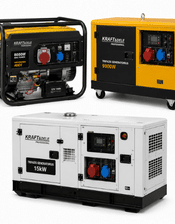
Three-phase generators, also known as 400 V generators, are designed for more than just backup power during electricity outages. They are particularly useful on construction sites, in workshops, farms, industrial facilities and other locations where three-phase electric motors, machinery, pumps, compressors or other 400 V equipment is used.
However, a three-phase generator is not automatically a better choice than a single-phase model. If most of your equipment operates on 230 V, an incorrectly selected 400 V generator may actually be less practical than a single-phase generator of similar power.
Before choosing a generator, it is therefore important to understand when a three-phase generator is actually required and how to select the correct power rating.
A three-phase generator should primarily be chosen when you need to power 400 V electrical equipment.
Typical examples include:
In these situations, the generator must provide a 400 V three-phase output and sufficient power not only to operate the equipment but also to start it.
A standard single-phase generator supplies 230 V single-phase power, which means that a conventional 400 V three-phase electric motor or other three-phase equipment cannot normally be connected directly to it.
A three-phase generator provides three-phase power and allows equipment requiring a 400 V three-phase electrical supply to operate.
The choice should therefore be based not simply on whether a generator is labelled “three-phase”, but on the specific equipment you intend to power.
This is one of the most common mistakes when choosing a generator.
If a three-phase generator has a total rated output of, for example, 7.5 kW, this does not necessarily mean that a 7.5 kW load can be connected to one of its 230 V sockets.
In a typical three-phase generator, the available power is distributed between the phases. The maximum permissible load on an individual phase depends on the generator design and the specifications provided by the manufacturer.
Therefore, if you intend to use the generator mainly for 230 V appliances, always check:
If your main requirement is to power high-demand 230 V appliances, a single-phase 230 V generator will often be the more practical choice.
If the generator will only be used for:
a three-phase generator is usually unnecessary.
In this situation, a 230 V single-phase generator may be more practical because its output is not distributed across three phases in the same way as with a typical three-phase generator.
Do you have 400 V equipment? → Choose a three-phase generator.
Will you only use 230 V equipment? → In most cases, choose a single-phase generator.
Will you use both 230 V and 400 V equipment? → A three-phase generator may be suitable, but the distribution of 230 V loads between phases must be considered.
A generator should not be selected simply by adding together the rated power of all connected equipment.
You should consider:
For example, if a three-phase electric motor has a rated output of 3 kW, this does not automatically mean that a 3 kW generator will be sufficient.
During start-up, an electric motor may temporarily require significantly more current than during normal operation. The actual starting demand depends on the motor type, starting method and mechanical load.
The generator therefore needs a sufficient starting power reserve.
Electric motors, compressors, pumps and other inductive loads can place a high temporary demand on a generator during start-up.
If the generator is undersized:
For this reason, a three-phase generator intended for electric motors should be selected according to the actual starting characteristics of the equipment, rather than simply matching the kW rating shown on its nameplate.
When using a three-phase generator, it is important to distribute the load as evenly as possible between the phases.
For example, if several high-power 230 V appliances are connected to different circuits, you should avoid a situation where almost the entire load is placed on one phase while the other phases remain lightly loaded.
A significant phase imbalance may negatively affect generator operating conditions and voltage stability.
This is especially important when a three-phase generator is used as a backup power source for a building.
Yes, but two different situations should be distinguished.
If a building has a three-phase electrical supply and the aim is to provide backup power to its electrical installation, a three-phase generator may be used.
However, this does not mean that the generator can simply be connected to any household socket.
A backup generator installation must include an appropriate switching and protection system that prevents generator power from being fed back into the public electricity grid.
The connection method and electrical installation should be assessed and installed by a qualified electrician.
It is also important to plan how the building's 230 V loads will be distributed across the three phases.
Many modern generators are equipped with an AVR (Automatic Voltage Regulator) system.
AVR helps regulate the generator's output voltage as the electrical load changes.
This can be useful when operating power tools, electric motors and other equipment. However, it is important to understand that an AVR generator is not the same as an inverter generator.
AVR regulates the generator's voltage, while inverter generators use a different electronic power conversion system to produce their output.
The correct choice depends on how the generator will be used.
A three-phase AVR generator is commonly chosen when you need:
An inverter generator is more commonly chosen when the priorities include:
Three-phase inverter generators are available, but the selection is generally much smaller and their price is usually higher than that of conventional three-phase AVR generators.
Usually suitable for:
Petrol generators are generally lighter and have a lower initial purchase price.
More commonly chosen for:
If the generator will operate for many hours and be used regularly, a diesel model may be worth considering.
An electric starter is particularly convenient on higher-powered generators.
It is recommended when:
If you plan to use an ATS (Automatic Transfer Switch) system, always check in advance whether the specific generator model supports it.
The generator's total power rating alone does not determine how much load can be connected to a particular socket.
You must also consider the type of outlets installed on the generator and their rated current.
Higher-powered three-phase equipment may require a 400 V / 32 A CEE socket, while lower-power equipment may use a 400 V / 16 A connection.
Before purchasing a generator, check which plug and electrical connection your equipment requires.
The most important criteria include:
Voltage – do you actually require a 400 V three-phase supply?
Rated power – how much power can the generator supply continuously?
Maximum power – short-term maximum output should not be confused with continuous rated power.
400 V output – how much power is available in three-phase operation?
230 V output – what is the permitted single-phase load?
Starting current – particularly important for motors, pumps and compressors.
Sockets – 230 V, 400 V / 16 A, 400 V / 32 A or other connections.
AVR – useful for maintaining more stable voltage.
Electric starter – convenient on larger generators.
ATS compatibility – important for automatic backup power systems.
Fuel tank capacity and operating time – important for extended operation.
Noise level – particularly relevant in residential areas.
A 400 V generator is not automatically better than a 230 V generator.
If all of your equipment is single-phase, a high-output three-phase generator may actually be less convenient because the load on individual phases must be taken into account.
A three-phase generator is worth choosing when 400 V output is genuinely required by your equipment or electrical system.
Only 230 V household appliances and power tools
→ Choose a single-phase 230 V generator.
400 V machinery, electric motors, compressors or pumps
→ Choose a three-phase 400 V generator.
Both 230 V and 400 V equipment
→ A three-phase generator may be suitable, but check the available single-phase output and distribute loads correctly.
Backup power for a three-phase house or commercial building
→ A three-phase generator may be appropriate, but a suitable transfer system and professionally designed electrical connection are required.
Sensitive electronic equipment is the main load
→ Consider an inverter generator or another power solution specifically suitable for the equipment.
A three-phase generator is the right choice when you need a 400 V electrical supply for three-phase equipment or backup power for a three-phase electrical system.
The generator should not be selected solely according to its total power rating. It is important to consider 400 V and 230 V output specifications, permitted load per phase, starting currents, the type of connected equipment and the required power reserve.
A correctly selected three-phase generator can reliably power machinery, electric motors, compressors, pumps and other professional equipment, while proper load distribution helps ensure more stable and reliable operation.