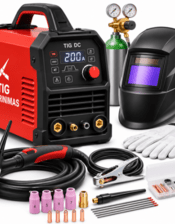
TIG Welding

TIG Welding

TIG welding machines are designed for precise welding using a non-consumable tungsten electrode and suitable shielding gas. TIG (Tungsten Inert Gas) welding provides controlled weld-pool operation and is used for metal fabrication, stainless steel products, aluminium components and other compatible materials.

The Irankistai.lt category includes TIG AC/DC welding machines such as Sherman DIGITIG 200 AC/DC MULTIPRO, DIGITIG 200GD PULSE, DIGITIG 218 AC/DC MULTIWAVE, DIGITIG 315GD PULSE and SPARTUS EasyTIG 200XP AC/DC. Active models include 230 V and 400 V machines with different TIG current ranges. Check individual product specifications and supplied accessories.

TIG AC/DC welding machines: AC vs DC

  • DC TIG (direct current). Commonly used for steel, stainless steel and other materials compatible with DC TIG. The appropriate mode and polarity depend on the material and procedure.
  • AC TIG (alternating current). Widely used for welding aluminium and selected aluminium alloys. Alternating current helps control oxide cleaning and weld penetration.
  • AC/DC TIG. A versatile option for workshops welding aluminium alongside steel or stainless steel.

How to choose a TIG welding machine

  • Materials. For conventional TIG welding of aluminium, choose a suitable AC/DC machine. DC TIG is often sufficient for steel and stainless steel.
  • Power supply. The category includes 230 V machines and the three-phase 400 V Sherman DIGITIG 315GD PULSE. Check electrical supply and protective installation requirements.
  • Welding current. Evaluate minimum and maximum current against material thickness. Precise low-current adjustment matters for thin workpieces.
  • Duty cycle. Compare welding current and duty cycle together. For example, the catalogue lists DIGITIG 200 AC/DC MULTIPRO at 200 A / 60% and DIGITIG 200GD PULSE at 200 A / 40%.
  • Arc ignition. HF starting initiates the arc without direct tungsten contact, while Lift TIG uses controlled contact starting.
  • Controls. Consider pulse mode, AC balance, AC frequency, current slope settings, 2T/4T operation and parameter memory.
  • Supplied accessories. Check whether the TIG torch, return cable, gas regulator, hoses and other accessories are included.

Pulse TIG welding

TIG PULSE alternates welding current between higher pulse and lower background levels. Properly selected settings can help control heat input, weld-pool behaviour and bead formation, particularly on thinner materials. Pulse frequency, duty and background-current controls vary by machine.

Welding aluminium with TIG AC/DC

Successful aluminium TIG welding requires more than AC capability. Select a suitable tungsten electrode, filler rod, shielding gas and surface preparation procedure. AC balance and frequency controls can help adapt the arc to the application. Remove contamination and oxide appropriately before welding.

Essential TIG welding accessories

  • Tungsten electrodes. Select according to current type, material and manufacturer guidance.
  • TIG torch and consumables. Ceramic cups, collets, collet bodies and related parts must match the torch.
  • Shielding gas. Argon is commonly used; suitable argon-helium mixtures are used for selected applications.
  • Filler rods. Choose filler material according to the base alloy and welding procedure.
  • Gas supply equipment. Use compatible regulators, hoses and fittings for the cylinder and process.

TIG vs MMA vs MIG/MAG welding

TIG is often chosen where precise heat and weld-bead control matter. MMA is practical for repair and installation work without an external shielding gas cylinder. MIG/MAG uses continuously fed wire and is often convenient for higher-volume or repetitive work. Selection depends on material, quality requirements, productivity and working conditions.

TIG welding safety

Use a suitable welding helmet, gloves, protective clothing and effective ventilation. Check gas-cylinder securing, regulator condition, hoses and electrical connections. TIG welding can produce intense ultraviolet radiation and hazardous fumes. Follow the machine manufacturer's safety instructions.

Frequently asked questions

Can a DC TIG welder weld aluminium?

AC is generally preferred for conventional aluminium TIG welding. Specialised DC procedures may be possible only under appropriate conditions.

What is the difference between AC TIG and DC TIG?

AC uses alternating current and is commonly used for aluminium, while DC uses direct current and is commonly used for steel and stainless steel.

Does TIG welding require shielding gas?

Yes. Conventional TIG welding requires a suitable inert shielding gas, most commonly argon.

What is the benefit of pulse TIG?

It alternates pulse and background current, which can help control heat input and the weld pool.

What is the difference between HF and Lift TIG starting?

HF starts the arc without touching the workpiece, while Lift TIG uses controlled electrode contact and lifting.

Can a TIG AC/DC welder also perform stick welding?

Only if the specific machine also supports MMA mode. Some models in this category do, but features must be checked individually.


Technical specifications Parameter Value Brand and model KR..
€39900
Technical specifications Input supply 230 V AC ±10% / 50 Hz TI..
€58900
Technical specifications Input supply 1 × 230 V ±10%, 50/60 Hz ..
€75000
Write
Call us
