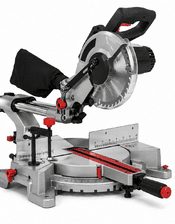
Mitre saws are designed for precise crosscuts, mitre cuts and bevel cuts in timber, boards, battens, skirting boards, mouldings and other workpieces. When choosing a mitre saw, the most important factors are the size of the material you plan to cut, the required cutting depth and width, available cutting angles, and how frequently the machine will be used.
Blade diameter is directly related to the cutting capacity of the saw. Common mitre saw blade sizes range from approximately 210 to 305 mm.
210–216 mm models are compact and suitable for battens, mouldings, skirting boards and smaller timber workpieces.
250–255 mm blades provide a versatile option for workshops, renovation and construction work where different sizes of material need to be cut.
305 mm mitre saws are designed for larger and thicker workpieces and are therefore often preferred for more demanding or professional applications.
Blade diameter alone does not determine the actual cutting capacity. Always check the manufacturer's specified maximum cutting depth and width.
If you plan to cut wider boards, flooring, worktops or other large workpieces, consider choosing a sliding mitre saw.
The sliding mechanism allows the saw head to move forwards and backwards, significantly increasing the maximum cutting width compared with a non-sliding saw using a similar blade diameter.
For smaller workpieces, a sliding mechanism may not be essential, but it considerably increases the versatility of the saw.
These are among the most important specifications when choosing a mitre saw.
Maximum cutting width indicates how wide a workpiece can be cut in a single pass. This is particularly important when comparing sliding mitre saws.
Maximum cutting depth indicates the maximum thickness of material the saw can cut.
Keep in mind that maximum cutting dimensions usually decrease when making 45° mitre or bevel cuts, so it is worth comparing the manufacturer's specified cutting capacities at different angles.
Mitre saws can perform much more than standard 90° crosscuts.
A rotating table allows the material to be cut at different horizontal mitre angles, such as 45°.
A tilting saw head allows bevel cuts to be made.
If the saw head can tilt to both the left and right, the workpiece does not need to be turned around as often. This is particularly convenient when cutting mouldings, skirting boards, profiles and performing more complex woodworking tasks.
Higher motor power can be useful when cutting thicker and harder materials, but wattage alone should not determine your choice.
Consider the complete specification, including motor power, blade diameter, rotational speed, cutting capacity and overall construction stability.
For occasional DIY work, a simpler model may be sufficient. For regular workshop use, a more robust machine designed for higher workloads is usually a better choice.
If the mitre saw will be used for furniture making, finishing work or other applications where precision is important, consider:
Choosing a high-quality saw blade suitable for the material being cut is also important for achieving clean and accurate results.
Cutting wood generates a significant amount of sawdust and dust. For regular use, it is worth choosing a model with a dust extraction port that can be connected to a suitable dust extractor or industrial vacuum cleaner.
Effective dust extraction helps keep the workplace cleaner and improves visibility around the cutting area.
For smaller DIY and finishing jobs – a compact 210–216 mm mitre saw is usually sufficient.
For versatile workshop use – consider a 250–255 mm model with a sliding mechanism.
For wider boards and workpieces – prioritise a large cutting width and sliding mechanism.
For larger timber workpieces – consider a 305 mm class mitre saw and pay particular attention to its maximum cutting depth.
For precise woodworking and finishing – look beyond motor power and consider construction stability, accurate angle adjustment, secure workpiece clamping and a suitable saw blade.
When choosing a mitre saw, it is recommended to compare maximum cutting width and depth, blade diameter, sliding mechanism and available mitre and bevel angles first. These specifications provide the clearest indication of the size of workpieces and types of cuts that can be handled by a particular saw.