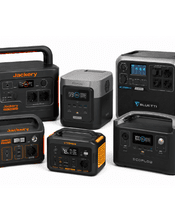
A portable power station, also known as a portable power supply, is a battery-powered energy storage device that allows you to power and charge electrical devices where mains electricity is unavailable or during temporary power outages.
Unlike a petrol or diesel generator, a portable power station does not generate electricity – it stores energy in a battery and supplies that energy to connected devices when needed.
Portable power stations can be used at home, in holiday properties, garages, motorhomes, while travelling or camping, for outdoor work, or as a backup power source.
When choosing a portable power station, it is essential to understand two key specifications:
Wh (watt-hours) – how much energy the power station can store.
W (watts) – how powerful the connected devices can be.
These are two different specifications, and both are important.
A portable power station typically consists of:
The integrated inverter converts the battery's DC power into 230 V AC power, allowing various standard electrical devices to be connected, provided their power requirements do not exceed the capabilities of the power station.
Depending on its battery capacity and output power, a portable power station can be used for:
Higher-powered power stations can also operate more demanding appliances, but you should always check their rated and starting power requirements.
This is one of the most important concepts when choosing a portable power station.
Wh (watt-hours) indicates how much energy the power station's battery can store.
For example:
222 Wh means that the battery has a nominal energy capacity of 222 watt-hours.
In theory, this could mean:
However, these are theoretical calculations.
Actual operating time will be shorter because of:
Wh should therefore primarily be used to compare the energy storage capacity of different power stations.
W (watts) indicates how powerful the devices connected to the power station can be.
For example, if the power station has a rated output of:
200 W,
you should not connect a device that continuously requires 500 W.
Even if the power station has a large battery, its inverter may not be powerful enough to operate such a device.
In simple terms:
Wh = approximately how long energy can be supplied.
W = how powerful a device can be connected.
Some power station specifications include:
Rated Power / Continuous Power – the power that can be supplied continuously;
Peak Power – the maximum short-term output.
For example:
200 W Rated / 320 W Peak.
This does not mean that the power station can continuously operate a 320 W appliance.
The 320 W figure represents short-term maximum output, which may be required when certain devices start.
Continuous loads should be planned according to the 200 W rated output.
Some electrical devices temporarily require more power during start-up.
This is particularly relevant to equipment containing:
For example, a device may consume 150 W during normal operation but temporarily require considerably more power when starting.
If the power station's inverter cannot handle this starting load, its protection system may switch off the 230 V output.
Therefore, before connecting such equipment, check both its rated power and its starting power requirement.
For a simple preliminary calculation, you can use:
Operating time ≈ power station capacity in Wh ÷ device power in W
For example:
Power station – 500 Wh
Device – 50 W
Theoretical operating time:
500 Wh ÷ 50 W = 10 hours
In real-world conditions, however, some energy is lost during power conversion and system operation.
Actual operating time will therefore be shorter.
The higher the electrical load and conversion losses, the more the real-world result may differ from the theoretical calculation.
Suitable for:
These compact power stations are particularly suitable for travelling and short-term backup power.
Suitable for:
These larger energy storage systems can be useful for:
Large-capacity power stations can be used as a more substantial backup power solution.
However, remember that a high Wh capacity does not automatically mean high output power – always check the inverter's W rating as well.
The power station's output should be selected according to the most powerful appliance you intend to use and the total load of devices that may operate simultaneously.
Primarily suitable for:
Suitable for a wider range of devices and more demanding equipment, although the power requirement of each appliance must still be checked.
Higher-powered stations can operate certain household appliances and some power tools.
However, even with a 2000 W power station, you should always check the appliance's rated and starting power requirements.
If the power station will be used with 230 V appliances, it is worth checking the type of AC output produced by the inverter.
Quality power stations often provide a Pure Sine Wave output.
This can be particularly important for:
If you plan to connect expensive or sensitive equipment, always check the power station's output specifications and the requirements of the connected device.
Depending on the model, a portable power station may include:
Used for standard electrical appliances.
Suitable for smartphones, tablets and other electronic devices.
Newer power stations may include USB-C Power Delivery ports capable of charging smartphones, tablets and laptops.
Check not only the connector type but also its maximum output power.
Can be used for automotive and other compatible 12 V equipment.
The available connections and their specifications depend on the individual power station.
Depending on the model, portable power stations can be recharged in several ways.
Usually the simplest and often the fastest charging method.
Useful while travelling, although charging may take longer.
Some portable power stations support solar charging.
This is particularly useful for:
Before purchasing a solar panel, check the power station's solar input voltage range, current, maximum input power and connector type.
Yes, but its capabilities depend on its battery capacity and output power.
A smaller power station may be suitable for:
A larger and more powerful station can operate more equipment.
Before planning backup power, determine:
These are two different solutions.
Advantages:
Limitations:
Advantages:
However, a generator:
These devices also serve different purposes.
A UPS is primarily designed to automatically maintain power to connected equipment when the mains electricity supply fails.
UPS systems are commonly used for:
The main advantage of a portable power station is mobility and the ability to use stored energy in different locations.
Some portable power stations include a UPS or EPS function, but the functionality and transfer time depend on the specific model.
A portable power station should therefore not automatically be considered equivalent to a dedicated UPS – always check the manufacturer's specifications.
Portable power stations can use different lithium battery technologies.
Common types include:
Battery technology can affect:
When comparing portable power stations, it is therefore worth checking not only the Wh capacity but also the battery chemistry and the manufacturer's specified cycle life.
BMS (Battery Management System) is the system responsible for monitoring and managing the battery.
Depending on the design, it may monitor:
A BMS is an important part of a modern portable power station, helping manage battery operation and protection functions.
The most important specifications include:
Battery capacity (Wh)
→ indicates how much energy can be stored.
Rated output power (W)
→ indicates the load the power station can continuously supply.
Peak Power
→ maximum short-term output.
230 V AC output type
→ for sensitive equipment, consider a Pure Sine Wave output.
Battery technology
→ Li-ion, LiFePO4 or another chemistry.
Battery cycle life
→ helps compare expected battery longevity according to the manufacturer's testing method.
USB ports
→ check USB-A, USB-C and their maximum output power.
12 V outputs
→ useful for automotive and other 12 V equipment.
Solar charging
→ check input voltage, current, maximum power and connector compatibility.
Charging time
→ particularly important when the station is used frequently.
Weight and dimensions
→ important for mobile applications.
UPS / EPS function
→ important if the power station will be used as a backup power source.
For smartphones, laptops and small electronics
→ Focus on Wh capacity and the required USB connections.
For 230 V appliances
→ Check both Wh capacity and the inverter's rated W output.
For a refrigerator, pump or other motor-driven equipment
→ Always consider starting power.
For sensitive electronics
→ Consider a model with a Pure Sine Wave 230 V AC output.
For motorhomes and travelling
→ Consider capacity, weight, 12 V outputs and solar charging capability.
For home backup power
→ Calculate how many watts your essential appliances consume and how many hours they need to operate.
For extended use away from mains electricity
→ Consider a higher-capacity power station and the possibility of using compatible solar panels.
When choosing a portable power station, the most important thing is to understand the difference between battery capacity in Wh and output power in W.
Wh indicates how much energy the power station can store and therefore has a major influence on potential operating time. W indicates how powerful the electrical devices connected to the power station can be.
If the power station will mainly be used for smartphones, laptops and small electronics, a compact lower-capacity model may be sufficient. For motorhomes, holiday properties or backup power, a larger battery capacity may be more suitable. If you want to operate higher-powered 230 V appliances, the inverter's rated and peak output must also be considered.
It is also worth checking the battery technology, 230 V AC waveform, USB and 12 V connections, charging time and whether the power station supports compatible solar charging.