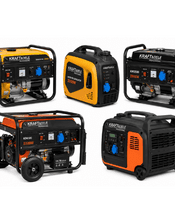
A single-phase generator supplies 230 V single-phase electricity, which is used by most household appliances, power tools and other common electrical equipment. It is one of the most versatile choices for homes, holiday properties, construction sites, workshops, mobile applications and backup power.
Single-phase generators are available in many different configurations – from small portable inverter generators to powerful petrol or diesel models designed to provide backup power for houses, workshops or professional equipment.
When choosing a generator, you should therefore answer several key questions: what equipment will the generator power, how much output is required, how long will it operate and what level of electrical power quality is required by the connected equipment?
A single-phase generator produces 230 V electricity commonly used in household electrical systems.
Depending on the generator's power output and technical specifications, it can be used to power:
If all of your equipment operates on 230 V and there is no need to power three-phase 400 V equipment, a single-phase generator is usually the most practical choice.
This is one of the most common questions when choosing a generator.
If you only use 230 V equipment, you should generally choose a single-phase generator.
A three-phase generator is primarily required when you need to power 400 V equipment such as:
It is important to understand that a higher-output three-phase generator does not necessarily provide its entire rated power through a single 230 V phase.
Therefore, if all your equipment operates on 230 V, a single-phase generator will often allow you to use the available generator capacity more effectively.
Single-phase generators can be divided into several main categories.
Petrol generators are among the most popular choices for household and occasional professional use.
They are commonly selected for:
Petrol generators are generally lighter and less expensive than diesel generators designed for similar applications.
They are particularly suitable when the generator is used occasionally or for shorter operating periods.
Diesel generators are worth considering when the generator:
Diesel generators are generally preferred when regular and extended generator operation is important.
Most small inverter generators are 230 V single-phase models.
They are particularly suitable when you prioritise:
Inverter generators are particularly popular for holiday properties, motorhomes, camping and as backup power sources for electronic equipment.
Single-phase generators can use different voltage regulation technologies.
AVR (Automatic Voltage Regulator) helps regulate the generator's output voltage as the electrical load changes.
AVR generators are commonly used for:
They are often a good choice when you need higher power output at a practical price.
In an inverter generator, the electrical output is additionally processed by an electronic power conversion system.
An inverter generator is worth choosing when your priorities include:
Importantly, AVR and inverter technology are not the same thing.
Generator output is one of the most important selection criteria.
First, make a list of all appliances and equipment that will need to operate simultaneously.
For example:
However, simply adding these figures together is not always sufficient.
Some equipment requires significantly more power during start-up than during normal operation.
Electric motors and equipment with compressors may temporarily require several times more current during start-up.
This is particularly important for:
For example, a 1,000 W water pump does not necessarily mean that a 1,000 W generator will be sufficient.
You must consider the specific equipment's starting characteristics and the generator's ability to handle short-term loads.
A generator should not be selected so that it constantly operates at its maximum output during normal use.
Additional power reserve is useful because:
The exact amount of reserve required depends on the equipment being powered.
Simple resistive loads may require only a relatively small reserve, while motors, pumps and compressors may require considerably more.
When comparing generators, it is important to distinguish between two specifications.
Rated power – the output that the generator can provide during normal operation under the conditions specified by the manufacturer.
Maximum power – the highest output the generator can provide for a limited period.
For example, if the generator specifications state:
Maximum power – 3.5 kW
Rated power – 3.0 kW
you should use the 3.0 kW rated output when planning continuous electrical loads rather than relying on the advertised maximum output of 3.5 kW.
Single-phase generators can be roughly divided into several power categories.
Suitable for:
Inverter generators are particularly popular in this category.
A versatile category suitable for:
Suitable for higher electrical loads:
High-output single-phase generators can be used for:
In this power category, it is particularly important to check the current rating of the generator's sockets and connections.
This is an often overlooked specification.
A standard 230 V / 16 A socket can theoretically supply approximately:
230 V × 16 A ≈ 3.68 kW.
Therefore, even if a generator can produce, for example, 6 kW, you cannot draw the entire 6 kW through a single 16 A socket.
Higher-powered single-phase generators may include a 230 V / 32 A CEE socket, which allows significantly higher power to be supplied through one connection.
If you plan to power a single high-demand 230 V appliance or machine, check not only the generator's total output but also the maximum current rating of the specific output socket.
Smaller generators are commonly started using a recoil starter.
Larger models may include:
An electric starter is particularly convenient when:
If a generator is used to provide backup electricity for a house or another property, an ATS (Automatic Transfer Switch) system may be useful.
A correctly designed system can detect a mains power failure, initiate the start-up of a compatible generator and transfer the electrical supply to the generator.
When mains electricity is restored, the system can transfer the load back to the grid and stop the generator.
However, not all generators support ATS, so compatibility must be checked before purchasing.
Connection of a generator to a building's electrical system should be carried out by a qualified professional.
The first question should not necessarily be: “What is the maximum electrical capacity of my house?”
It is more useful to determine which appliances actually need to remain operational during a power outage.
For example:
Calculate their combined simultaneous power requirements, consider starting currents and then select the appropriate generator.
In many situations, it is more economical to use the generator to supply priority circuits rather than attempting to power every electrical appliance in the house simultaneously.
For construction applications, the most important considerations usually include:
If the generator will power angle grinders, saws, rotary hammers, compressors or other higher-demand equipment, their starting loads must also be considered.
For intensive professional use, it is worth comparing petrol and diesel generators.
If the main electrical loads include:
an inverter generator is worth considering.
Before connecting expensive or particularly sensitive equipment, it is also recommended to check the specific generator's electrical output characteristics and the equipment manufacturer's requirements.
A larger fuel tank does not necessarily mean that a generator is better, but it can be an important factor for extended operation.
Operating time depends on:
When comparing generators, consider not only the fuel tank capacity but also the manufacturer's specified operating time at a particular load level.
If the generator will be used in a residential environment, noise can be an important consideration.
Open-frame petrol and diesel generators are generally louder.
Enclosed inverter or “Silent” generators usually operate more quietly.
When comparing different models, check the manufacturer's specified noise level in dB as well as the distance and operating load under which the measurement was taken.
For home and backup power
→ Calculate the power requirements and starting loads of essential 230 V equipment.
For a holiday home and occasional power outages
→ A petrol 230 V generator is often sufficient.
For computers and sensitive electronics
→ Consider an inverter generator.
For construction sites and power tools
→ A higher-output petrol or diesel AVR generator is often suitable.
For long and regular operation
→ Consider a diesel generator.
For motorhomes, travelling and mobile use
→ A compact inverter generator is usually the most practical option.
For a single high-powered 230 V load
→ Check not only the generator's output but also the maximum current of its 230 V socket – a 32 A connection may be required.
If you have 400 V equipment
→ A single-phase generator is not suitable – you will need a three-phase 400 V generator.
A single-phase 230 V generator is a versatile choice for homes, holiday properties, construction sites, workshops and most common electrical equipment.
When choosing a generator, the goal should not simply be to find the model with the highest kW rating. Instead, correctly evaluate the actual simultaneous power demand, starting currents, generator rated output, expected operating time and required electrical power quality.
If the generator will only be used occasionally, a petrol model will often be sufficient. For longer and more intensive operation, a diesel generator may be worth considering, while an inverter generator is particularly suitable for sensitive electronics, mobile applications and situations where lower noise levels are important.
If all of your equipment operates on 230 V, a single-phase generator will usually allow you to use the available generator output more simply and efficiently than a three-phase model.