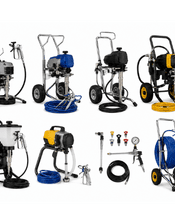
Airless paint spraying equipment is designed for fast and even coating of large surfaces without the use of compressed air. Paint is supplied under high pressure directly to the spray gun and atomised through a special spray tip. This technology provides high productivity and is suitable for painting walls, ceilings, façades, fences, structures and many other surfaces.
When choosing an airless paint sprayer, the most important factors to consider are the scale of the work, type of paint, flow rate, maximum working pressure and supported spray tip size.
First, determine how often the equipment will be used and how large the surfaces will be.
For small and occasional jobs – such as painting apartments, rooms, smaller walls or fences – a compact airless paint sprayer may be sufficient.
For larger renovation and construction projects, choose a more powerful and productive model capable of operating for longer periods and efficiently covering large walls, ceilings or façades.
For professional use, consider not only pressure but also paint flow rate, pump durability and the ability to use larger spray tips.
Paint delivery capacity is usually specified in litres per minute (l/min) and indicates how much material the sprayer can pump within a certain period.
A higher flow rate allows you to:
Maximum pressure alone does not determine the actual performance of an airless sprayer. For professional applications, flow rate is often one of the most important specifications.
Airless paint sprayers atomise paint using high pressure. Sufficient pressure helps properly atomise the coating and produce an even spray pattern.
Higher maximum pressure provides greater flexibility when working with different coatings. However, the sprayer should not be selected solely according to its maximum pressure. It is important to consider the combination of pressure, flow rate and spray tip size.
Spray tip size has a significant impact on paint flow and determines what types and viscosities of coatings can be sprayed.
Smaller tips are generally suitable for thinner coatings and more precise applications, while larger tips allow a higher material flow and are better suited to thicker coatings.
Before purchasing, check the maximum spray tip size supported by the airless paint sprayer.
Not all airless paint sprayers are equally suitable for every coating. Always check whether the equipment is compatible with the material you intend to spray.
Depending on the sprayer and manufacturer's specifications, airless equipment may be suitable for:
When working with thicker materials, the sprayer's flow rate and supported spray tip size become particularly important. Always follow the recommendations of both the paint and equipment manufacturers.
When painting larger areas, the length of the high-pressure hose is also important. A longer hose provides a larger working range without having to move the sprayer itself.
This is particularly useful when painting:
For professional applications, also consider the mobility and construction of the machine, the quality of the hose and spray gun, and the availability of replacement and consumable parts.
Adjustable pressure allows the sprayer to be adapted to different coatings, spray tips and surfaces.
It is generally recommended to start with a lower pressure and gradually increase it until an even spray pattern is achieved. Excessive pressure does not necessarily improve the finish and may increase overspray, spray tip wear and material consumption.
For home renovation and smaller projects, choose a compact model if you plan to occasionally paint walls, ceilings, fences or other smaller areas.
For larger construction and finishing projects, a higher-performance sprayer with a greater paint flow rate and support for larger spray tips is recommended.
For professional and intensive use, choose high-performance equipment designed for longer operating periods, large surfaces and a wider range of coating materials.
When choosing airless paint spraying equipment, do not rely solely on motor power or maximum pressure. Consider paint flow rate, maximum spray tip size, coating type, workload and equipment construction together. This will help you select a sprayer that is better suited to the intended application and allows you to work faster and more efficiently.