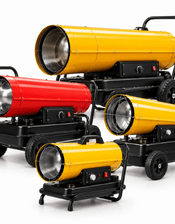
Diesel heaters provide powerful and mobile heating for larger working areas. They are commonly used on construction sites and in workshops, warehouses, hangars, industrial premises and other locations where rapid and effective heating is required.
One of the main advantages of diesel heaters is their high heating capacity and ability to operate in locations where sufficient electrical power is unavailable. Electricity is generally required for the fan, fuel pump and control system, while diesel fuel provides the main source of heat.
A diesel heater burns fuel in a combustion chamber while a fan creates a strong airflow to transfer heat into the required area.
Depending on the design, diesel heaters can use direct or indirect combustion. Understanding this difference is important when choosing a heater for a particular working environment.
In a direct-fired heater, the heat generated during combustion is supplied directly into the heated area together with the airflow.
These heaters provide high heating output and are useful when a large, well-ventilated working area needs to be heated quickly.
Typical applications include:
construction sites;
well-ventilated warehouses;
hangars;
workshops;
industrial premises;
other large working areas.
Because combustion products enter the heated area, adequate ventilation must be provided and the operating requirements specified by the heater manufacturer must always be followed.
Indirect-fired heaters separate the combustion process from the warm air supplied to the heated area. Depending on the specific design, combustion gases can be discharged through a separate exhaust system.
These heaters are more suitable for applications where heated air needs to be supplied without combustion gases entering the heated area.
Always follow the installation, exhaust and ventilation requirements specified for the particular model.
The required heating capacity should not be determined by floor area alone. Consider:
total floor area and room volume;
ceiling height;
wall and roof insulation;
outdoor temperature;
desired indoor temperature;
doors, gates and windows;
ventilation and draughts.
A well-insulated warehouse may require significantly less heating capacity than an uninsulated hangar of the same size.
For larger spaces, total volume in m³ and expected heat loss should therefore be considered rather than relying only on floor area in m².
For regular use, a diesel heater equipped with a thermostat can provide more convenient temperature control.
A thermostat allows the desired temperature to be selected and, depending on the functions of the specific model, can automatically control heater operation. This helps prevent unnecessary overheating and makes it easier to maintain a comfortable working temperature.
Some models may also feature digital displays, temperature indicators and multiple operating modes.
A diesel heater can be a practical choice for larger garages and workshops where electric heating cannot provide sufficient output.
However, the type of heater is important. Direct-fired models require adequate air exchange, so the manufacturer's operating requirements must be carefully considered when heating enclosed or regularly occupied working areas.
Diesel heaters are widely used on construction sites because of their high heating capacity, mobility and ability to provide heat quickly.
They can be used for temporary heating of working areas, but the type of heater should always be selected according to ventilation, occupancy and the intended application specified by the manufacturer.
Both technologies can provide high heating output.
Diesel heaters use an integrated or separate fuel tank and can be convenient for longer periods of independent operation. They are commonly used on construction sites and in warehouses and larger workshops.
Gas heaters are often more compact and lightweight but require a suitable gas cylinder, hose and regulator.
The choice should depend on the heated area, available fuel, required heating capacity and operating conditions.
An electric heater is a simple solution for smaller enclosed spaces where a suitable electrical supply is available.
A diesel heater becomes particularly useful when high heating capacity is required and the available electrical system cannot support the necessary load.
For this reason, diesel heating can be a practical option for larger workshops, warehouses, hangars and construction sites.
When choosing a diesel heater, consider:
heating capacity (kW);
direct or indirect combustion;
fuel consumption;
fuel tank capacity;
airflow (m³/h);
thermostat functionality;
temperature control;
electrical supply requirements;
heater weight and portability;
ventilation requirements.
A correctly selected diesel heater can provide rapid and effective heating for large working areas. Instead of simply choosing the highest-output model, select a heater whose capacity and operating principle are appropriate for the size, insulation and operating conditions of the space.
Important: always follow the manufacturer's operating and safety instructions. Adequate ventilation is particularly important when using direct-fired diesel heaters.