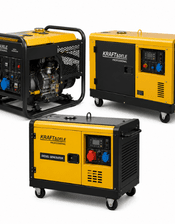
A diesel generator is usually the preferred choice when electricity needs to be generated regularly, for extended periods, or when the generator serves as an important backup power source. Compared with petrol generators, diesel models are generally better suited to heavier workloads, longer operating periods and more intensive use.
However, a diesel generator is not necessarily the best choice in every situation. If you only need a generator occasionally, for a few hours per year or to power low-demand equipment, a petrol generator may be a more economical option.
Before purchasing a generator, it is therefore important to consider not only its power output but also how often, how long and under what conditions it will be used.
A diesel generator is particularly suitable when you need:
The main advantages of a diesel generator become particularly relevant when the generator is not simply an emergency device used occasionally, but a regular source of electrical power.
The main differences become more noticeable as generator usage increases.
Diesel engines are generally well suited to longer operating periods and higher workloads. For this reason, diesel generators are widely used for professional, commercial and regular applications.
Suitable for longer operating periods
Diesel engines are commonly used in equipment designed to operate for many working hours. This makes diesel generators popular on construction sites, farms, industrial facilities and in backup power systems.
Fuel efficiency during intensive use
Under comparable operating conditions, diesel engines can often provide lower fuel consumption than petrol engines designed for similar applications.
The more frequently a generator is used, the more important fuel consumption becomes when evaluating total operating costs.
Suitable for higher electrical loads
Diesel generators are commonly used to power electric motors, pumps, compressors, construction equipment, workshop machinery and other higher-demand electrical loads.
Suitable for backup power systems
Diesel generators are widely used as backup electricity sources for residential, commercial, agricultural and industrial properties.
A diesel generator should not be selected simply because it is considered a more professional option.
A petrol generator may be more practical if:
For example, if a generator is purchased for a holiday home and will only be used a few times per year during power outages, a petrol model may be perfectly sufficient.
If the generator is expected to operate regularly for several hours or longer, a diesel model becomes more attractive.
Yes. A diesel generator can be an excellent backup power source for a house, particularly in areas where power outages are frequent or last for extended periods.
However, the first step is to determine which appliances and systems need to remain operational during a power outage.
Priority is usually given to:
You do not necessarily need a generator capable of powering every electrical appliance in the house simultaneously.
In many cases, it is more economical to create priority circuits that receive generator power during an electricity outage.
Diesel generators can be particularly practical for farms, where higher-powered equipment is commonly used.
A generator may be used to power:
If three-phase 400 V equipment is used, an appropriately sized three-phase diesel generator should be selected.
Generators used on construction sites often operate for longer periods and under heavier loads than generators used only as emergency backup power for a house.
A diesel generator can be suitable for:
However, it is important to consider not only the total rated power of the equipment but also the starting current requirements of electric motors and other inductive loads.
Start by making a list of all equipment that will need to operate from the generator.
Consider:
A generator should generally not be operated continuously at its absolute maximum output.
An appropriate power reserve helps the generator operate more reliably as loads change and provides additional capacity for other equipment when required.
Some electrical devices temporarily require significantly more power during start-up than during normal operation.
This is particularly important for:
For example, a “2 kW” rating on an electric motor does not necessarily mean that a 2 kW generator will be sufficient.
During start-up, the electrical demand can be several times higher. The generator should therefore be selected according to the actual starting characteristics of the connected equipment.
This is one of the most important decisions when choosing a generator.
Choose a single-phase model if you intend to power:
If you do not have any 400 V equipment, a single-phase generator will usually be the more practical choice.
Choose a three-phase model when you need to power:
It is important to remember that the total rated power of a three-phase generator may not necessarily be available through a single 230 V phase.
When using a three-phase generator to power 230 V equipment, you must therefore consider the maximum permitted load per phase and proper load distribution between phases.
Diesel generators are available as open-frame models or enclosed in sound-reducing housings.
Advantages include:
This type of generator is suitable for construction sites, workshops and other environments where noise is not the primary concern.
A sound-reducing enclosure can significantly reduce the amount of noise produced by the generator.
This type of generator is worth considering for:
However, “Silent” does not mean completely silent. Always check the manufacturer's specified noise level in dB when comparing generators.
AVR (Automatic Voltage Regulator) helps regulate the generator's output voltage as the electrical load changes.
AVR is a useful feature when a generator is used to power different types of electrical equipment. However, an AVR generator is not the same as an inverter generator.
If particularly sensitive electronic equipment will be connected, consider not only whether AVR is present but also the generator's electrical output characteristics and the requirements specified by the connected equipment manufacturer.
An electric starter is particularly practical on diesel generators.
It allows the generator to be started using a key or button and is recommended when:
ATS (Automatic Transfer Switch) is an automatic backup power transfer system.
In a correctly designed installation, when mains electricity fails, the ATS system can initiate generator start-up and transfer the electrical supply from the grid to the generator. Once mains electricity is restored, the system can transfer the load back to the grid and stop the generator.
ATS can be particularly useful for:
Importantly, not every generator supports ATS, so compatibility should always be checked before purchasing.
Connection of a generator to a building's electrical installation and installation of an ATS system should be carried out by a qualified professional.
The most important specifications include:
Rated power – the amount of power the generator can supply during normal operation.
Maximum power – short-term maximum output should not be treated as continuous operating power.
230 V or 400 V – select according to the equipment you intend to power.
Starting power requirements – particularly important for motors, compressors and pumps.
AVR – helps regulate generator output voltage.
Electric starter – provides easier and more convenient starting.
ATS compatibility – important for automatic backup power systems.
Fuel tank capacity – affects how long the generator can operate without refuelling.
Fuel consumption – particularly important when the generator is used frequently.
Noise level – an important consideration in residential and commercial areas.
Weight and wheels – important if the generator needs to be transported or moved regularly.
The generator will be used occasionally and for short periods
→ A petrol generator will usually be sufficient.
The generator will operate regularly and for longer periods
→ Consider a diesel generator.
You need a lighter and more portable generator
→ A petrol generator is often more practical.
The generator is intended for a farm, workshop or industrial application
→ A diesel generator is often the more practical option.
You need backup power for a house or commercial property
→ A diesel generator can be an excellent choice, particularly when longer operating periods are expected.
You need automatic backup power
→ Look for a generator compatible with an ATS system.
You need to power 400 V equipment
→ Choose a three-phase generator and consider both the required operating power and starting current.
A diesel generator is worth choosing when the most important requirements are longer operating periods, regular use, higher electrical loads and reliable backup power.
For a house, farm, construction site, workshop or commercial property, a correctly selected diesel generator can provide a practical long-term power solution.
Before purchasing, determine the required generator output, whether you need 230 V or 400 V, the starting current requirements of connected equipment, expected operating duration and whether automatic ATS operation is required.
If the generator will only be used occasionally and for short periods, a petrol model may be the more economical option. However, as operating hours and usage intensity increase, the advantages of a diesel generator become increasingly important.