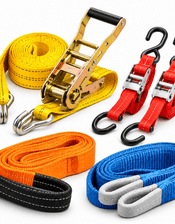
Cargo securing and towing straps serve different purposes in load restraint, transport and vehicle recovery operations. The Irankistai.lt range includes lashing straps, towing straps, elastic securing cords and pulling chains. Choosing the correct equipment requires consideration of its intended application, length, connection hardware and manufacturer-specified load limits. Load restraint, towing and lifting equipment must not be treated as interchangeable.
Start by determining whether you need to secure a load during transport or tow a vehicle. These applications have different load-rating systems, so an advertised tonnage figure alone is insufficient.
Cargo lashing straps are used when transporting machinery, tools and other loads on trailers or commercial vehicles. Towing straps are used to pull vehicles, while elastic cords can help retain lighter items. The suitability of pulling chains must be checked against the documentation for each specific product.
Before use, consider load weight, attachment points, sharp edges and the manufacturer's instructions. A breaking-strength rating must not be confused with a permitted working load. Cargo lashing straps are not designed for lifting loads.
A lashing strap secures cargo during transport, while a towing strap is intended for towing a vehicle. Their construction and load requirements differ.
No. Breaking strength is not the same as the permitted working load. Follow the manufacturer's specified limits and intended use.
Elastic cords should not be treated as heavy-duty cargo restraint equipment unless the manufacturer explicitly specifies the relevant application and load ratings.