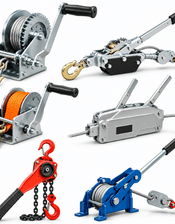
Manual pulling winches and cable pullers are mechanical tools used to pull and position suitably secured loads, equipment and other objects. The Irankistai.lt range includes hand-operated drum winches, lever-operated cable pullers and ratchet chain binders. When choosing equipment, consider pulling force, working rope length, attachment points and the manufacturer's operating restrictions.
Types of manual pulling equipment
Manual drum winches. Hand-cranked mechanisms that wind a rope onto a drum. The PD00GR product group includes variants with catalogue pulling ratings from 450 to 1361 kg.
Manual cable pullers. Lever-operated tools with ropes and hooks for pulling operations permitted by the manufacturer. Active products include TOHO MODEL1000 and MODEL3000, QSS2TA1 and QSS4TA2E.
Ratchet chain binders. Mechanical devices used to tension chains for their approved applications. The TOHO RTLB00 is available with different catalogue load markings.
How to choose a manual pulling winch
Pulling rating. Compare the catalogue pulling rating with the manufacturer's permitted working load. These values are not necessarily interchangeable.
Rope length. Distinguish total rope length from usable working travel. For example, the TOHO MODEL3000 has a total rope length of 3 m and a listed working length of 1.4 m.
Operating mechanism. Hand-cranked drum winches and lever-operated cable pullers differ in construction, control method and available travel.
Attachment points. Verify that supports, hooks, connectors and pulling direction are suitable for the expected forces.
Intended use. A ratchet chain binder is not automatically suitable for use as a lifting hoist or cable puller.
Manual pulling winches for workshops and equipment maintenance
Hand-operated pulling mechanisms can be used for controlled pulling and positioning tasks where an electric drive is not required. For example, the QSS2TA1 has a listed 2 t pulling designation and 1.1 m working rope length, while the QSS4TA2E has a 4 t designation and 1.2 m working length. TOHO MODEL1000 and MODEL3000 differ in their rated markings, rope diameters and working travel.
Before use, inspect ropes, hooks, latches, handles and mounting points. Follow the manufacturer's operating limits and stay clear of tensioned ropes. Do not use pulling tools to lift suspended loads or people unless specifically designed and approved for that purpose.
Frequently asked questions
What is the difference between a hand winch and a cable puller?
A manual drum winch generally winds a rope onto a drum using a hand crank, while a cable puller is usually operated by a lever and has a limited working travel.
What do 2 t and 4 t cable puller ratings mean?
These are catalogue pulling designations. The actual permitted working load and operating conditions must be verified in the instructions for the specific model.
Can a cable puller lift a load vertically?
Only if the specific equipment has been approved by its manufacturer for that purpose. Pulling tools must not be treated as lifting equipment solely on the basis of their pulling rating.