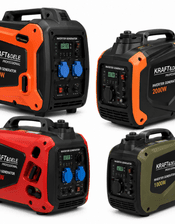
An inverter generator is an excellent choice when stable electrical power, fuel-efficient operation, lower noise levels and portability are important. These generators are particularly popular for powering sensitive electronic equipment and for use at homes, holiday properties, campsites, motorhomes and mobile workplaces where extremely high power output is not required.
However, an inverter generator is not automatically the best solution for every application. If you need high power for a construction site, 400 V three-phase equipment, large electric motors or intensive operation over extended periods, a conventional petrol or diesel generator may be more suitable.
Before purchasing, it is therefore important to understand how an inverter generator differs from a conventional generator and when the advantages of inverter technology are genuinely useful.
In a conventional generator, the characteristics of the electrical output are closely related to the operating speed of the engine and alternator.
An inverter generator uses an additional electronic power conversion system. The electricity produced by the generator is electronically processed before a controlled AC output is supplied to connected equipment.
This technology allows an inverter generator to:
These characteristics are among the main reasons why inverter generators are commonly chosen for electronic equipment and household applications.
An inverter generator is particularly suitable when you intend to power:
It is also practical for travelling, holiday homes, motorhomes, camping, mobile retail locations and other applications where portability, fuel efficiency and lower noise levels are important.
For electronic equipment, the voltage rating alone is not the only important factor.
Electrical power quality and stability are also important. Significant voltage or frequency fluctuations can affect the operation of sensitive electronic devices.
Inverter technology electronically processes and controls the generator's electrical output. As a result, a quality inverter generator will generally provide more stable output characteristics.
For this reason, inverter generators are commonly selected for computers, electronic controllers and other equipment where electrical power quality is particularly important.
However, before connecting especially sensitive or expensive equipment, always check both the generator's technical specifications and the requirements specified by the equipment manufacturer.
These two technologies are often confused.
AVR (Automatic Voltage Regulator) is an automatic voltage regulation system used in many conventional generators. Its purpose is to help maintain the generator's output voltage as the electrical load changes.
An inverter generator uses electronic power conversion and output waveform control.
Therefore:
AVR generator ≠ inverter generator.
An AVR generator can be an excellent choice for power tools, construction equipment, pumps, compressors and many other applications.
An inverter generator is more commonly selected when the priorities are power quality, lower noise levels, fuel efficiency and portability.
A conventional generator engine often needs to maintain a certain operating speed to produce electricity at the required frequency.
Inverter technology allows the engine operating speed to be adjusted more flexibly according to the electrical load.
When only a small load is connected, the engine can operate at a lower speed.
This can:
This advantage is particularly noticeable when the generator operates for long periods at partial rather than maximum load.
Generally, yes.
Many inverter generators use enclosed housings, sound-reducing construction and automatic engine speed adjustment according to electrical demand.
As a result, they often operate more quietly than conventional open-frame generators designed for similar applications.
This is particularly useful when using a generator:
However, noise levels can vary significantly between models. Always compare the manufacturer's specified noise level in dB and the conditions under which it was measured.
An inverter generator can be an excellent backup power source for a house if you do not need to operate all high-power electrical appliances simultaneously.
It can be used to power essential equipment and systems such as:
In this situation, the generator does not necessarily need to match the entire electrical capacity of the house.
Instead, calculate which priority appliances actually need to remain operational during a power outage.
This is one of the applications where the advantages of inverter technology are particularly useful.
Important factors in these situations include:
For these reasons, small and medium-sized inverter generators are commonly selected for motorhomes, holiday properties, camping and mobile workplaces.
Yes, provided that the generator has sufficient power.
An inverter generator can be used to power:
However, for professional construction work where several high-power tools are used simultaneously, an inverter generator may not always be the most economical solution.
In such cases, a conventional high-output AVR generator may provide a more practical and cost-effective solution.
First determine which appliances or machines will operate from the generator simultaneously.
Consider:
For example, a refrigerator may consume relatively little power during normal operation, but its compressor can require significantly more power for a short period during start-up.
The same principle applies to pumps, compressors and electric motors.
Therefore, a generator should not be selected solely according to the normal operating power of connected equipment.
This is an important distinction.
Rated power is the output the generator can provide during normal operation under the conditions specified by the manufacturer.
Maximum power is the highest output available for a limited period.
For example, if a generator is advertised as a 3.5 kW model, always check whether 3.5 kW refers to its rated or maximum output.
A generator should not be selected with the intention of operating continuously at its maximum power limit.
Many inverter generators include an ECO or Economy mode.
When electrical demand is low, the generator automatically reduces engine speed.
As demand increases, the engine speed increases accordingly.
ECO mode can help:
If the generator will frequently operate under partial load, ECO mode is a useful feature.
Some inverter generators can be connected in parallel using a compatible system specified by the manufacturer.
This allows two compatible generators to provide greater combined output.
It can be a practical solution when one smaller generator is sufficient for everyday use but additional power is occasionally required.
Only use a parallel connection system specifically designed and approved for the generator models being used.
A conventional AVR or diesel generator may be a more practical solution when:
In these situations, it is worth comparing inverter generators with conventional AVR and diesel generators.
Computers, electronics and electronic controllers
→ An inverter generator is usually worth considering.
Motorhome, holiday home or camping
→ An inverter generator is often more practical because of its lower noise levels and compact design.
Occasional backup power for a house
→ Either type may be suitable depending on the required power and connected equipment.
Construction sites and high-power tools
→ A conventional AVR generator is often more economical.
Long and intensive operating periods
→ Consider comparing the inverter model with a diesel generator.
400 V three-phase equipment
→ A three-phase AVR or diesel generator will often be the more practical choice.
Most small portable inverter generators use petrol engines.
A petrol inverter generator is worth choosing when you prioritise:
A diesel generator is worth considering when you prioritise:
These two generator types therefore often serve different purposes.
The most important criteria include:
Rated power – how much power the generator can provide during normal operation.
Maximum power – the maximum short-term output of the generator.
Starting power requirements – particularly important for refrigerators, pumps, compressors and electric motors.
Electrical output characteristics – especially important for sensitive electronic equipment.
ECO mode – can reduce fuel consumption and noise under lighter loads.
Fuel tank capacity and operating time – important for extended use.
Noise level – compare the manufacturer's dB specifications and measurement conditions.
Weight and dimensions – particularly important for portable applications.
Number and type of sockets – consider which equipment you intend to connect.
Electric starter – can provide additional convenience on larger models.
Parallel operation capability – useful if additional power may be required in the future.
You need power for computers and electronic equipment
→ An inverter generator is one of the main options to consider.
Lower noise levels are important
→ Consider an enclosed inverter generator.
The generator will be used in a motorhome, holiday home or while camping
→ An inverter generator is often a very practical choice.
The generator will frequently operate under light loads
→ An inverter generator with ECO mode can provide more economical operation.
You need high power for construction or professional equipment
→ Compare it with a conventional AVR generator.
You require long and intensive operating periods
→ Consider a diesel generator.
You require 400 V three-phase power
→ Consider a three-phase generator; the selection of three-phase inverter models is generally more limited.
An inverter generator is worth choosing when the priorities are stable electrical power, lower noise levels, efficient operation under partial load and portability.
It is particularly well suited to homes, holiday properties, motorhomes, camping and powering electronic equipment.
However, a generator should always be selected according to its actual intended use. If the main requirement is to power high-demand tools, 400 V equipment or operate the generator intensively for many hours, a conventional AVR or diesel generator may be the more practical choice.
Before purchasing, consider the rated power, starting current requirements of connected equipment, expected operating time, noise level, fuel consumption and electrical output characteristics.