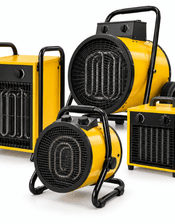
Electric heaters are a practical and easy-to-use solution for heating garages, workshops, warehouses, construction areas and other working spaces. They require no diesel fuel or gas cylinders and produce no combustion gases inside the heated area.
When choosing an electric heater, the most important factors are heating capacity, room size and insulation, and the available power supply – 230 V or 400 V.
One of the main advantages of electric heating is simple operation. Connect the heater to a suitable electrical supply and select the required operating mode.
Electric heaters are particularly useful for:
garages and workshops;
supplementary warehouse heating;
construction and renovation work;
temporary space heating;
locations where storing diesel fuel or gas cylinders is undesirable;
applications where heating without combustion gases inside the room is preferred.
Many electric heaters use a built-in fan to distribute heated air throughout the room.
The required heating capacity depends on more than just floor area. Ceiling height, thermal insulation, outdoor temperature, desired indoor temperature and heat loss through doors, gates and windows should also be considered.
As a general guide:
Lower-output electric heaters are suitable for smaller workshops, garages and individual working areas.
Medium-output heaters can be used in larger garages, workshops, construction areas and commercial premises.
High-output heaters are designed for warehouses, larger workshops and other spaces requiring more intensive heating.
The poorer the insulation and the greater the difference between outdoor and desired indoor temperature, the greater the heating capacity required.
This is one of the most important considerations when choosing an electric heater.
230 V electric heaters can operate from a suitable standard single-phase electrical installation. They are generally used for smaller spaces and applications that do not require very high heating output.
400 V electric heaters require a three-phase electrical supply and are generally available with higher heating capacities. They are suitable for larger workshops, warehouses, construction sites and industrial premises.
Before connecting a high-power heater, make sure that the electrical installation, socket and protective devices are suitable for the load required by the specific unit.
An electric heater is a convenient choice for a garage that is used periodically and needs to be heated quickly before work begins.
A smaller, well-insulated garage may require only a compact heater, while a large, high-ceilinged or poorly insulated garage will require significantly more heating capacity.
Frequent opening of garage doors should also be considered because it can result in substantial heat loss.
In workshops, electric heaters can provide either primary or supplementary heating. Fan-assisted models are particularly useful when a specific working area needs to be heated quickly.
On construction sites, electric heaters can provide temporary heating and help maintain suitable working conditions. Because there is no direct fuel combustion inside the room, they do not introduce combustion gases or additional combustion-related moisture in the same way as some direct-fired heaters.
When choosing an electric heater, consider:
heating capacity (kW);
230 V or 400 V power supply;
floor area and total room volume;
thermal insulation;
thermostat and temperature control;
available power settings;
fan performance;
heater size and portability.
A correctly selected electric heater provides a simple and practical way to heat a garage, workshop, warehouse or construction area. If a suitable electrical supply is available and you prefer not to use gas or diesel fuel, electric heating can be one of the most convenient options.