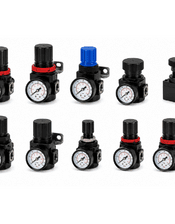
Air flow and pressure regulators are compressed-air system components used to control air supply conditions for paint spray guns, pneumatic tools, compressors and other air-powered equipment. A properly selected regulator helps establish the required operating conditions and reduce the risks associated with incorrect pressure.
The Irankistai.lt category includes pressure regulators with gauges, compact regulators with threaded or quick-connect fittings and digital models. Important selection criteria include connection size, pressure range, measurement method, airflow capacity and the requirements of the connected tool.
An air pressure regulator is designed to set or maintain the required pressure in a pneumatic system. An air flow regulator restricts or adjusts airflow. Although these terms are sometimes used together, pressure and flow are different physical quantities.
Many products in this category feature a pressure gauge and are described as pressure regulators. A gauge displays pressure rather than directly measuring air consumption in litres per minute. Always check the actual functions in the individual product specifications.
A regulator with a pressure gauge allows the user to monitor the set pressure and prepare spray painting or other pneumatic equipment for operation. Depending on the model, it may be installed in a compressor air line or near the tool.
Active models include:
Before purchase, check whether a stated pressure value refers to maximum inlet pressure, the adjustable range or another parameter. These values are not interchangeable.
A digital regulator displays pressure readings electronically. This can be convenient when a clearly readable pressure value is important for more precise painting work.
The category includes the active 3263 digital air pressure regulator with a listed 0.275–11 bar range. Check the individual product specifications for connection configuration, power supply and operating restrictions.
Paint spray guns require the manufacturer-recommended working pressure at the gun's air inlet. Pressure that is too low or too high may affect spray characteristics and coating quality.
A regulator with a gauge can help set the pressure, but it cannot compensate for insufficient compressor airflow. Clean, dry compressed air is also important, as are pressure losses through hoses, filters and fittings.
When selecting a regulator, verify the thread size and standard. This category includes products with 1/4-inch and G3/8-inch connections. Nominal size alone does not establish compatibility between different thread standards.
Before installation, check male or female threads, the sealing method, airflow direction and quick-coupling profile where applicable. Incorrect connections may cause air leaks.
Before installation, disconnect the air supply and release remaining system pressure. Install the regulator according to the manufacturer's airflow direction, use compatible fittings and an appropriate sealing method. Check for leaks after installation.
Regularly inspect the pressure gauge, connection tightness and regulation mechanism. Do not exceed the manufacturer's pressure limits or modify the regulator's construction.
A pressure regulator controls pressure, while a flow regulator controls airflow. Check each product's specifications to confirm its functions.
A pressure gauge displays air pressure and helps establish the required working conditions. It does not directly measure air consumption in litres per minute.
Yes, provided its pressure range, connections and airflow capacity meet the spray gun's requirements.
No. They have different nominal sizes, so compatible fittings or a suitable adapter are required.
No. It controls air supply conditions but does not increase the compressor's delivered airflow.
A digital model uses an electronic display, while an analogue model typically uses a mechanical pressure gauge. Accuracy depends on the individual instrument.
Disconnect compressed air, release pressure, verify fitting compatibility and follow the manufacturer's installation instructions.