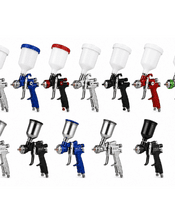
Choosing the right spray gun helps achieve an even finish, reduce paint consumption and work more efficiently. When selecting a spray gun, consider not only its type but also the nozzle size, operating pressure, air consumption, paint cup position and the capacity of your air compressor.
HVLP (High Volume Low Pressure) spray guns use a relatively high volume of air at low pressure. They provide efficient paint transfer and help reduce excessive overspray. HVLP guns are widely used for automotive painting, furniture finishing, metal structures and various finishing jobs.
Before choosing an HVLP gun, make sure your air compressor can supply the required airflow.
LVLP (Low Volume Low Pressure) spray guns generally require less compressed air and can therefore be a practical choice when using a smaller compressor. They are particularly suitable for smaller and more precise painting jobs.
The correct nozzle size depends on the viscosity of the material and the type of work being performed. Always check the recommendations provided by the paint or coating manufacturer.
Common nozzle sizes include:
A nozzle that is too small for a thick material can restrict paint flow, while an excessively large nozzle can deliver too much material and make it more difficult to achieve an even finish.
Air consumption. Check how many litres of air per minute the spray gun requires. Your compressor must be capable of providing sufficient actual airflow at the required operating pressure.
Operating pressure. Follow the manufacturer's recommended pressure. Excessive pressure can increase overspray and material waste, while insufficient pressure can result in poor atomisation.
Paint cup position. Gravity-feed guns use a top-mounted cup and are a popular choice for automotive, furniture and precision finishing applications. Bottom-feed cups can be convenient when larger quantities of paint are required.
Adjustment options. Separate controls for airflow, material flow and spray pattern width make it easier to adapt the gun to different surfaces and coatings.
Ergonomics and cleaning. For frequent use, consider the weight and balance of the gun, handle comfort, build quality and how easily the nozzle and internal paint passages can be cleaned.
For general-purpose painting, an HVLP or LVLP spray gun with an approximately 1.3–1.4 mm nozzle is often a versatile choice. Larger nozzles are generally required for primers and thicker materials, while a compact Mini spray gun can be more convenient for small parts, spot repairs and detailed work.
The most important factor is to match the spray gun not only to the surface being painted but also to the coating being used and the available compressor capacity.