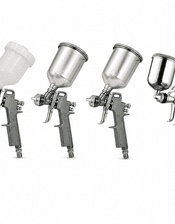
HP high-pressure paint spray guns are pneumatic tools designed to apply compatible paints, primers, clear coats and other coatings using compressed air. HP (High Pressure) spray technology is used in automotive repair, metal finishing, woodworking and general workshop painting. A correctly selected spray gun allows the operator to adjust material delivery and the spray pattern for the task.
The Irankistai.lt category includes HP spray guns with different nozzle diameters and compressed-air requirements. Selection should consider nozzle size, compressor capacity, operating pressure, cup volume and the technical requirements of the coating material.
HP (High Pressure) is a pneumatic spray technology in which compressed air atomises the coating material. Traditional HP spray guns generally operate at higher air pressures than HVLP or LVLP systems. They can provide fine atomisation but may also create more overspray.
Results depend on the spray gun design, coating properties, pressure, spraying distance and operator technique. HP spraying should not be confused with Airless spraying, which uses a different operating principle.
The active range includes two HP spray guns with 1.5 mm nozzles and 600 ml cups:
Although both models share the same nozzle diameter and cup capacity, their pressure ranges, air consumption and spray pattern widths differ. Match the choice to your compressor's capability and the coating manufacturer's instructions.
Nozzle diameter influences material delivery and spray characteristics. Smaller openings are often selected for suitable lower-viscosity coatings and finer work, while larger openings may be useful for higher-viscosity materials when approved by the manufacturer.
The technical specifications of models assigned to this category include 0.5 mm, 1.5 mm, 1.7 mm and 2.5 mm nozzle variants, although not all models are currently active. Check current availability and the coating's technical data sheet before purchase. Nozzle diameter alone does not establish compatibility with a particular paint, primer or clear coat.
When choosing a compressor, its actual delivered airflow at the required working pressure is more important than tank volume or maximum pressure alone. For example, the 162A2 lists 350 L/min air consumption, while the W101S lists 400 L/min. The compressor must provide sufficient air for sustained operation, allowing for losses through hoses, fittings and filters.
Proper compressed-air preparation also matters. Depending on the coating, moisture control, oil contamination prevention and stable pressure may be necessary for a consistent finish.
The most suitable technology depends on the coating, job size, available compressor and required finish quality.
Before spraying, inspect the gun, nozzle, fittings and air supply. Set the equipment according to the manufacturer's instructions and perform a test spray. After use, clean the material passages and nozzle with compatible cleaning products. Disconnect the air supply and safely release pressure before maintenance.
Spray in a properly ventilated environment and use respiratory, eye and skin protection suitable for the coating. Follow all safety requirements for flammable materials and the working area.
HP stands for High Pressure, a pneumatic spraying method that uses compressed air and traditionally higher pressure than HVLP or LVLP systems.
They can be, provided the selected gun's specifications match the coating and the intended application.
Both use a 1.5 mm nozzle and 600 ml cup, but 162A2 specifies 3–4 bar and 350 L/min, while W101S specifies 3.5–5 bar and 400 L/min.
No. Compatibility depends on coating viscosity, manufacturer requirements and the specific spraying system.
It requires a compressor capable of delivering the model's specified airflow at working pressure. Check actual delivered air capacity.
No. HP spray guns use compressed air for atomisation, while Airless systems operate using a different, airless principle.
Clean the nozzle and material passages after each use according to the manufacturer's instructions, inspect seals and safely disconnect compressed air.