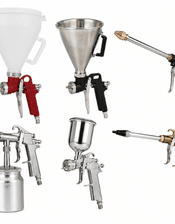
Hopper plaster guns, pneumatic paint spray guns and specialist spraying equipment are used to apply compatible paints, plastering mixtures and other manufacturer-approved coatings. Different spray systems are designed for different materials and applications, so the correct choice depends on material properties, nozzle size, compressed-air requirements and the working area.
At Irankistai.lt, the range includes a hopper spray gun, HP pneumatic paint spray guns and a pressure tank painting system. These products differ in material feeding method, container capacity and operating specifications and are not direct substitutes for one another.
A hopper spray gun is a pneumatic tool with a material container designed for spraying compatible plastering and textured coatings. Material is supplied from the hopper and distributed using compressed air. Always confirm that the coating viscosity and particle size are suitable for the selected tool and nozzle.
The HP01 features a 5 L hopper and interchangeable 4.0, 6.0 and 8.0 mm nozzles. Its listed working pressure is 4–6 bar, with air consumption of 113–170 L/min. The interchangeable nozzles allow the setup to be adapted to suitable sprayable materials.
A hopper gun can be useful for compatible decorative plaster and textured finishing tasks, but suitability must be verified against both the coating and equipment instructions.
HP spray guns use compressed air to atomise compatible coating materials. Selection depends on the coating's technical requirements, nozzle diameter, air consumption and desired spray pattern.
Although both models have the same nozzle diameter and cup capacity, their specified pressure ranges differ. A 1.5 mm nozzle alone does not establish suitability for every paint, primer or clear coat. Always consult the coating's technical data sheet.
A pressure tank spray system supplies coating material from a separate container rather than a small cup attached directly to the spray gun. This arrangement can be useful when a larger quantity of coating material is needed.
The PT2 is a pneumatic painting system with a 10 L pressure tank and a 2.0 mm spray nozzle. Check the permitted pressures of both the tank and spray gun separately, and ensure a suitable compressed-air supply. Before opening or servicing the tank, release pressure according to the manufacturer's instructions.
For pneumatic spray equipment, the compressor's actual delivered air capacity matters as much as its maximum pressure. The HP01 lists 113–170 L/min air consumption, while the 162C and W101S each list 400 L/min. The compressor must supply sufficient airflow at the required working pressure. Air preparation should also be considered according to the coating's requirements.
Before use, inspect the equipment, hose connections and nozzle, and verify coating compatibility. Perform a test spray. After work, clean material passages using manufacturer-approved products. Safely release pressure before disconnecting or servicing equipment. Ensure suitable ventilation and use personal protective equipment appropriate to the sprayed material.
A hopper gun has a larger material container and is intended for compatible thicker or textured materials. Conventional HP spray guns apply suitable paint coatings. Always follow the manufacturer's requirements.
The product listing specifies 4.0, 6.0 and 8.0 mm nozzles.
The HP01 lists 113–170 L/min air consumption and 4–6 bar working pressure. Assess compressor compatibility using its actual delivered airflow.
Both have a 1.5 mm nozzle and 600 ml cup, but 162C specifies 3–4 bar and W101S specifies 3.5–5 bar working pressure.
When supplying material from a separate larger container is more convenient. PT2 has a 10 L tank and a 2.0 mm nozzle.
No. Check material viscosity, particle size, nozzle diameter and the manufacturer's compatibility requirements.
No. Select nozzle size according to the coating's technical data sheet and perform a test spray.