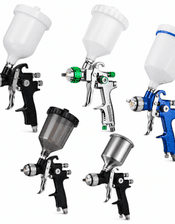
HVLP and LVLP paint spray guns are pneumatic tools used to apply compatible paints, clear coats, primers and other finishing materials. They are used for automotive refinishing, furniture manufacturing, woodworking, metal coating and general workshop painting. Choosing the correct equipment requires consideration of spray technology, nozzle size, operating pressure, air consumption and coating specifications.
The Irankistai.lt range includes HVLP and LVLP spray guns, selected RP technology models and spray gun kits from manufacturers including YATO, BGS technic, HYMAIR and SATA. Air requirements and spraying characteristics vary considerably between models.
HVLP (High Volume Low Pressure) technology uses a relatively high volume of air at low pressure. When properly adjusted, it can improve coating transfer efficiency and reduce overspray compared with certain traditional high-pressure spray systems.
HVLP guns require an adequate compressed-air supply. For example, the YATO YT-2340 has a 1.4 mm nozzle, 600 ml cup and listed air consumption of 410 L/min. The BGS technic 3317 has a 1.4 mm nozzle, 550 ml cup and listed air consumption of 141–283 L/min.
LVLP (Low Volume Low Pressure) technology is designed to operate with relatively low air consumption and pressure. It may be suitable for compressors with limited output, provided the specific model's airflow requirements are met.
The range includes HYMAIR AS100312 with a 1.2 mm nozzle and HYMAIR AS100317 with a 1.7 mm nozzle. Both list a 2.5 bar working pressure, 145 L/min air consumption and 600 ml cup. The RP2022 LVLP spray gun is also available with a 1.3 mm nozzle.
The category includes SATAjet 1000 B and SATAjet X 5500 spray guns in selected HVLP and RP configurations. RP is a separate spray technology and should not be confused with LVLP.
For example, SATAjet X 5500 HVLP models list 430 Nl/min air consumption, while corresponding RP versions list 290 Nl/min. Some models include a digital pressure display. Exact nozzle configuration and package contents depend on the selected version.
Nozzle diameter should be selected according to the coating manufacturer's technical data sheet. The category includes models and kits in the 1.2, 1.3, 1.4, 1.5, 1.7, 1.8, 2.0 and 2.5 mm classes.
Smaller nozzles may suit certain lower-viscosity coatings and finer applications, while larger openings may be suitable for some thicker materials. Nozzle size alone does not confirm compatibility with a particular primer, paint or clear coat.
Check the compressor's actual delivered airflow at the required working pressure, rather than relying on tank capacity or maximum pressure alone. For example, HYMAIR AS100312 lists 145 L/min, YATO YT-2340 lists 410 L/min and SATAjet X 5500 HVLP lists 430 Nl/min. Take account of the manufacturer's measurement conditions when comparing specifications expressed in different units.
Compressed-air preparation is also important, including moisture control, oil contamination prevention, pressure stability and losses through hoses and fittings.
Before use, inspect air connections, the nozzle, seals and coating compatibility. Perform a test spray and follow the manufacturer's recommended settings. After use, clean material passages with suitable products. Disconnect the compressed-air supply and release pressure before maintenance.
Work in a properly ventilated environment and use respiratory, eye and skin protection specified by the coating safety data sheet. Observe additional precautions when spraying hazardous or flammable materials.
HVLP uses a higher volume of air at low pressure, while LVLP is designed for lower air consumption. Exact requirements depend on the individual model.
Potentially, provided the compressor can supply the specified airflow at working pressure.
Yes, where the gun's specifications match the coating and intended application.
It depends on the primer formulation and manufacturer recommendations. Follow the coating's technical data sheet.
No. SATA RP is a separate manufacturer-specific spray technology and should not be classified as LVLP.
No. Air consumption varies between models, so check each product's technical specifications.
Clean the nozzle and material passages after use according to the manufacturer's instructions, inspect seals and safely disconnect compressed air.