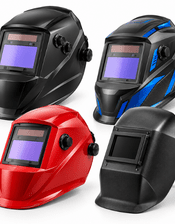
Welding helmets are essential protective equipment designed to protect the eyes and face from intense welding arc light, ultraviolet (UV) and infrared (IR) radiation, sparks and hot metal particles. A properly selected welding helmet improves both safety and visibility during welding.
At Irankistai.lt, you can explore welding helmets for different applications, from occasional DIY welding to regular workshop use.
An auto-darkening welding helmet features a special filter that automatically darkens when a welding arc is detected.
These helmets are a convenient choice for both beginners and experienced welders.
Main advantages include:
Automatic darkening when welding begins.
Improved workpiece visibility before striking the arc.
No need to repeatedly lift the helmet.
Adjustable shade levels, depending on the model.
Greater convenience during repetitive welding tasks.
Some models also allow adjustment of sensitivity and delay settings.
Traditional welding helmets use a fixed-shade protective filter. They have a simple design and do not require an electronic auto-darkening system.
They can be suitable for occasional welding when the correct filter shade is selected.
The DIN shade number indicates how much light passes through the welding filter. Higher numbers correspond to darker filters.
Many auto-darkening welding helmets offer adjustable shade ranges, such as DIN 9–13, although the exact range varies by model.
When selecting a shade, consider:
Welding process – MMA, MIG/MAG or TIG.
Welding current.
Ambient lighting conditions.
Manufacturer recommendations.
Always select the correct filter shade according to the welding process, current and applicable safety requirements.
MMA welding: Choose a helmet with a suitable shade range and reliable arc detection.
MIG/MAG welding: An auto-darkening helmet makes it easier to observe the weld area and perform repetitive welding operations.
TIG welding: Filter sensitivity and reliable arc detection at low welding currents are particularly important. Not all auto-darkening helmets are equally suitable for low-amperage TIG welding.
Important selection criteria include:
Shade range: Compatibility with the intended welding processes.
Optical quality: Image clarity, distortion and filter performance.
Switching speed: How quickly the filter darkens after detecting an arc.
Arc sensors: Their number and positioning can influence detection reliability.
Viewing area: A larger viewing window improves visibility.
Sensitivity adjustment: Useful for different welding processes.
Grinding mode: Available on selected models for suitable grinding applications.
Weight and headgear adjustment: Important for extended use.
Power supply: Battery type, solar assistance and replacement options.
Safety certification: Compliance with applicable eye and face protection requirements.
Some auto-darkening welding helmets include a GRIND mode, which disables automatic darkening for improved visibility during grinding.
Always verify that the helmet provides the required mechanical impact protection for the intended grinding operation. Additional protective equipment may be necessary.
Occasional DIY welding: A basic auto-darkening helmet with suitable shade adjustment may be sufficient.
Regular workshop use: Consider a helmet with adjustable sensitivity, a comfortable headband and good optical performance.
Professional welding: Prioritise optical quality, ergonomics, reliable arc detection and the availability of replacement lenses and protective covers.
Welding exposes the eyes and face to intense optical radiation and other hazards. Appropriate protective equipment is therefore essential.
When selecting a welding helmet, consider its safety certification, compatibility with your welding process and overall comfort.
A correctly selected welding helmet helps you perform MMA, MIG/MAG and TIG welding more safely and comfortably.