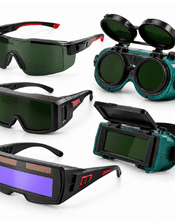
Welding goggles are specialised eye protection designed to protect the eyes from intense light, ultraviolet (UV) and infrared (IR) radiation and other hazards associated with welding and metalworking.
Depending on their design and protective filters, welding goggles may be suitable for certain welding, brazing, soldering, cutting and related operations.
At Irankistai.lt, you can explore welding goggles for different working conditions. When choosing a model, consider the filter shade, protective properties, comfort and applications approved by the manufacturer.
Fixed-Shade Welding Goggles
Fixed-shade welding goggles feature protective lenses with a predetermined shade level. They may be suitable for specific gas welding, cutting or brazing operations when the filter provides the required protection.
Auto-Darkening Welding Goggles
Auto-darkening welding goggles feature filters that automatically darken when a welding arc is detected.
They improve visibility before welding and provide automatic shade adjustment when the arc starts.
However, not all auto-darkening goggles are suitable for every welding process. Always check the manufacturer's approved applications and protection specifications.
The main difference is the area of protection.
Welding goggles primarily protect the eyes and may be suitable for specific gas welding, brazing, cutting or other approved operations.
Welding helmets protect both the eyes and a larger area of the face from arc radiation, sparks and hot metal particles.
For MMA, MIG/MAG and TIG arc welding, goggles alone are generally insufficient. Appropriate eye and face protection, usually a welding helmet, is required.
The filter shade number indicates the amount of visible light transmitted through the protective lens. Higher shade numbers correspond to darker filters.
When selecting a filter, consider:
the type of operation;
the welding or cutting process;
welding current or gas flow, depending on the process;
the manufacturer's specified protection level;
working conditions.
The correct shade must be selected according to the safety requirements of the specific process. Dark lenses alone do not guarantee adequate UV and IR protection.
Important factors include:
adjustable shade range;
filter switching speed;
sensitivity adjustment;
optical quality;
viewing area;
power supply;
fit and ergonomics;
manufacturer-approved applications;
compliance with applicable eye protection standards.
Always verify that the goggles are suitable for the intended welding process and provide the necessary protection.
Specialised protective goggles with appropriate filters may be used for certain brazing, gas welding and gas cutting applications.
It is important to select the correct protection level and consider additional hazards, such as hot metal particles and sparks.
Additional face protection may be required when there is a risk of splashes, sparks or flying particles.
When selecting welding goggles, check:
Intended application – approved welding and metalworking processes.
Filter type – fixed-shade or auto-darkening.
Shade level – suitability for the specific operation.
UV and IR protection – verified protective performance.
Impact resistance – protection against particles and mechanical hazards.
Comfort – weight, fit and adjustment options.
Certification – CE marking and applicable safety standards.
For brazing, gas welding and similar operations, correctly selected welding goggles can provide convenient eye protection.
For MMA, MIG/MAG and TIG arc welding, a suitable welding helmet providing the required eye and face protection is generally the appropriate choice.
Welding goggles should always be selected according to the intended application, filter protection level and manufacturer specifications. Safety should take priority over price or appearance.