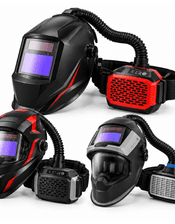
Welding helmets with air filtration systems combine eye and face protection with a powered air-purifying respirator. These systems help reduce exposure to hazardous airborne particles generated during welding operations.
They are particularly suitable for professional welders performing MMA, MIG/MAG and TIG welding in workshops, manufacturing facilities and metalworking environments.
Many systems use PAPR (Powered Air-Purifying Respirator) technology, which delivers filtered air to the welding helmet or protective headtop.
A typical system includes:
Auto-darkening welding helmet.
Powered air filtration unit.
High-efficiency particulate filter.
Air supply hose.
Rechargeable battery and controls.
Protective headtop or face seal.
The powered unit draws ambient air through a filter and delivers it to the user's breathing zone.
Particulate filters protect against specified airborne particles but do not automatically protect against all hazardous gases and vapours. The actual protection depends on the filters and certification of the specific system.
Respiratory protection – helps reduce inhalation of hazardous welding fume particles.
Eye and face protection – protects against welding radiation, sparks and hot metal particles.
Filtered airflow – delivers filtered air into the protective headtop.
Improved comfort – airflow may reduce heat and moisture accumulation.
Professional suitability – designed for regular welding applications.
These systems are particularly useful for:
Regular professional welding.
Metal fabrication and industrial production.
Stainless steel and alloy steel welding.
Workplaces with significant welding fume exposure.
Applications where a workplace risk assessment identifies the need for respiratory protection.
A PAPR welding helmet does not replace suitable local exhaust ventilation or general workplace ventilation.
Important selection criteria include:
Respiratory protection classification – verify certification and the assigned protection level.
Filter type – identify the contaminants the filter is designed to remove.
Airflow performance – ensure the required airflow is maintained.
Battery operating time – important for extended working shifts.
Replacement filters – availability and maintenance requirements.
Auto-darkening filter – DIN shade range, optical quality and sensitivity.
Comfort and ergonomics – weight, fit and headgear design.
System compatibility – all components must be approved for use together.
A standard auto-darkening welding helmet primarily protects the eyes and face from optical radiation and mechanical hazards.
A PAPR welding helmet additionally provides certified respiratory protection against the airborne contaminants for which the system is approved.
The correct choice depends on the welding process, materials, working environment and occupational risk assessment.
Before use, inspect the filters, airflow system, battery charge and all protective components.
Powered air-purifying respirators are not suitable for oxygen-deficient atmospheres and must not be used where contaminant concentrations exceed the manufacturer's permitted operating limits.
A correctly selected welding helmet with air filtration provides an integrated solution for eye, face and respiratory protection during professional welding operations.