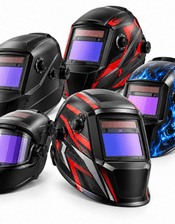
Auto-darkening welding helmets are advanced protective devices equipped with filters that automatically darken when a welding arc is detected. They are designed to protect the eyes and face from intense arc light, ultraviolet (UV) and infrared (IR) radiation, sparks and hot metal particles.
Auto-darkening welding helmets are suitable for both DIY users and professional welders working with MMA, MIG/MAG and TIG welding processes. They improve workpiece visibility before welding and reduce the need to repeatedly raise and lower the helmet.
The main component of an automatic welding helmet is the auto-darkening filter (ADF).
When the sensors detect a welding arc, the filter automatically switches from its light state to the selected dark shade.
After welding stops, the filter returns to its lighter state. Depending on the model, the user can adjust shade level, sensitivity and delay settings.
Automatic darkening – the filter responds to the welding arc.
Improved visibility – easier positioning of the workpiece before welding.
Convenient operation – no need to repeatedly lift the helmet.
Adjustable DIN shade – suitable for different welding processes.
Sensitivity adjustment – allows adaptation to different working conditions.
Improved comfort – adjustable headgear and lightweight construction can reduce discomfort during extended use.
Available functions vary depending on the specific model.
The DIN shade number indicates the light transmission level of the welding filter. Higher DIN values correspond to darker filters.
Many auto-darkening welding helmets offer adjustable shade ranges such as DIN 9–13. Some models provide wider adjustment ranges, including DIN 5–13.
The correct shade depends on the welding process, current and manufacturer's recommendations. Always select the appropriate filter setting for the specific welding conditions.
The optical quality of an auto-darkening welding filter may be classified using four numbers, such as 1/1/1/1 or 1/1/1/2 under the EN 379 classification system.
These values describe:
optical accuracy;
light diffusion;
uniformity of luminous transmittance;
angular dependence of luminous transmittance.
Class 1 represents the highest performance level in each category.
Good optical quality is particularly important during extended welding sessions and precision welding tasks.
MMA welding: Choose a helmet with a suitable shade range and reliable arc detection.
MIG/MAG welding: An auto-darkening helmet improves visibility and convenience during repetitive welding operations.
TIG welding: Filter sensitivity is especially important. For low-amperage TIG welding, choose a helmet specifically rated by the manufacturer for such applications.
Some auto-darkening helmets feature a grinding mode (GRIND), which disables automatic darkening and allows improved visibility during grinding operations.
Before using the helmet for grinding, verify that it provides adequate mechanical impact protection and is approved by the manufacturer for the intended application.
Important selection criteria include:
DIN shade range – compatibility with the intended welding processes.
Optical class – clarity and overall viewing quality.
Switching speed – how quickly the filter darkens.
Arc sensors – number, positioning and detection reliability.
Viewing area – a larger window improves visibility.
Sensitivity and delay adjustment – flexibility for different working conditions.
Grinding mode – useful when supported by the helmet.
Power supply – batteries, solar assistance and replacement options.
Weight and ergonomics – important for extended welding sessions.
Safety compliance – CE marking and applicable protective equipment standards.
For occasional DIY welding, a basic model with adjustable DIN shade and essential protective functions may be sufficient.
For regular workshop use, consider a helmet with adjustable sensitivity, delay settings, comfortable headgear and good optical performance.
For professional welding, prioritise optical quality, viewing area, reliable arc detection, ergonomics and the availability of replacement protective lenses.
A properly selected auto-darkening welding helmet helps make welding safer, more comfortable and more precise. When choosing a model, consider not only the price but also its technical specifications, protective features and intended frequency of use.