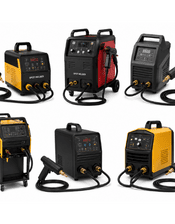
This technology is particularly useful when the damaged area is difficult or impossible to access from the inside. For this reason, spotters are widely used in professional automotive workshops, body repair shops, collision repair centers, and vehicle restoration work.
The main advantage of a spotter is the ability to straighten vehicle body panels from the outside. A special pulling element is welded onto the damaged area, allowing the deformation to be pulled out in a controlled manner.
A spotter can be used to:
A properly selected spotter can therefore significantly speed up the body repair process while providing greater control over sheet metal straightening.
When choosing a spotter, you should not focus on just one specification – the maximum welding current. For professional use, it is important to consider the combination of power, adjustment options, operating modes, included accessories, and compatibility with consumables and pulling tools.
A higher instantaneous welding current provides greater power reserve when welding pulling elements onto the body panel. A lower-powered machine may be sufficient for lighter and occasional body repair work, while professional workshops should consider a more powerful spotter.
Spotters in the 5,000–7,000 A range are a practical choice for many professional auto body repair applications. However, the amperage rating should not be the only factor considered when selecting a machine.
It is important that the spotter allows precise adjustment of the welding energy according to the thickness of the sheet metal and the type of pulling element being used.
A 230 V spotter is a versatile choice for small and medium-sized automotive workshops. It is easier to connect to the electrical supply and can also be suitable for mobile body repair work.
A 400 V spotter is worth considering for busy professional body shops where the equipment is used regularly and a greater power reserve is required.
Before purchasing a powerful spotter, it is also important to check the workshop's electrical installation and the power supply requirements specified by the manufacturer.
The more adjustable operating modes a spotter offers, the easier it is to adapt the machine to different types of body repair work.
Depending on the model and accessories used, a spotter can work with:
For professional workshops, it is advisable to choose a machine for which additional electrodes, holders, pulling elements, and consumables are readily available.
When comparing the prices of different spotters, it is important to consider not only the specifications of the machine itself but also what is included in the package.
A more comprehensive spotter kit may include:
A higher initial purchase price does not necessarily mean a more expensive overall solution if the package already includes most of the tools and accessories required for body repair work.
This is one of the most important criteria when choosing a spotter.
Standard auto body repair spotters are generally designed for steel body panels. They are used to weld pulling elements onto steel sheet metal so that the damaged area can be pulled back into shape.
If you plan to repair aluminium body panels, equipment specifically designed for aluminium and the appropriate repair technology are required. Before purchasing a spotter, always check which materials the particular machine is designed to work with.
For occasional and less demanding repairs – a simpler 230 V spotter with the essential pulling modes is a practical choice. It is an economical solution for workshops where body repair is not the primary activity.
For a professional automotive workshop – a more powerful spotter in approximately the 5,000–7,000 A range, with adjustable welding energy, multiple operating modes, and a comprehensive accessory package, is recommended. Such a machine provides greater flexibility when performing body repairs of varying complexity.
For intensive professional body repair work – choose professional-grade equipment and pay particular attention to the duty cycle, cooling system, cable quality, machine durability, and availability of spare parts and consumables.
For aluminium body repair – choose a spotter specifically designed for aluminium. A standard spotter designed for steel panels is not a universal alternative to a dedicated ALU repair system.
For professional use, the spotter itself is only part of the complete auto body dent-pulling system. Easy access to electrodes, holders, pulling tips, wavy wire, hooks, combs, and other consumables allows a single machine to be used for a much wider range of repair tasks.
Before purchasing, it is therefore worth considering not only the initial price of the spotter but also what types of repairs you will be able to perform, which accessories are available, and how easily the system can be expanded in the future.
A properly selected auto body repair spotter becomes a versatile workshop tool that allows damaged vehicle body panels to be restored faster, more accurately, and with greater control over the repair process.