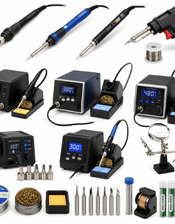
The right soldering station depends primarily on the type of work you plan to perform. A standard soldering station is usually suitable for soldering wires, connectors and electronic components, while a hot air station is particularly useful for installing and removing SMD components. If you perform a wide range of electronics repair tasks, a combined 2-in-1 station can be a practical choice.
A standard soldering station uses a soldering iron with a heated tip and adjustable temperature. It is suitable for many everyday soldering tasks, including:
When choosing a soldering station, consider its power, temperature adjustment range, heat-up time and available soldering tips.
For most general electronics work, a station with approximately 60–75 W of power is sufficient. Higher power can be useful when working with larger contacts or components that dissipate heat quickly.
In T12 soldering systems, the heating element and temperature sensor are integrated directly into the replaceable soldering tip. This design allows heat to be transferred efficiently to the tip and enables the station to respond quickly to temperature changes during soldering.
A T12 station is particularly useful when:
A hot air station heats components using a controlled flow of hot air instead of direct contact with a soldering tip. This is particularly useful when working with electronic circuit boards and components that are difficult or impractical to heat effectively with a conventional soldering iron.
Hot air stations are commonly used for:
When choosing a hot air station, consider its heating power, temperature range and airflow adjustment capabilities. A wider adjustment range makes it easier to adapt the station to different components and applications.
Temperature is not the only important parameter of a hot air station. Excessive airflow can move small electronic components, while insufficient airflow may not transfer enough heat to the working area.
For electronics repair, it is therefore worth choosing a station that allows you to adjust temperature and airflow independently.
A lower and more precisely directed airflow is generally suitable for small SMD components, while larger components or wider areas may require increased airflow.
If you perform different types of electronics repair at the same workstation, a 2-in-1 soldering station combining a conventional soldering iron with a hot air function can be a convenient solution.
The soldering iron can be used for wires, contacts, connectors and conventional electronic components, while the hot air function can be used for installing and removing SMD components.
A combined station is particularly practical for:
Power. Higher power generally allows the station to reach the selected temperature faster and maintain it more effectively when working with components that absorb or dissipate more heat.
Temperature range. A wider adjustable temperature range provides greater flexibility when working with different solder alloys, components and applications.
Temperature stability. For electronics repair, it is important not only to reach the required temperature but also to maintain it consistently during operation.
Heat-up time. This becomes particularly important when the station is used frequently. A fast-heating station reduces preparation time and allows you to start working sooner.
Airflow adjustment. On hot air stations, the ability to control airflow is one of the most important features.
Tips and nozzles. Different soldering tip shapes and hot air nozzle sizes allow the equipment to be adapted more precisely to specific tasks.
For wires, contacts, connectors and general electronics – choose a standard soldering station with adjustable temperature.
For frequent and more precise electronics soldering – consider a T12 soldering station.
For installing and removing SMD components – choose a hot air station with adjustable temperature and airflow.
For versatile electronics repair – a 2-in-1 station combining a soldering iron and hot air function is a practical choice.
If you regularly repair electronics, do not base your choice solely on the maximum power rating. Temperature stability, heat-up time, airflow control and the availability of suitable tips and nozzles often have a greater impact on working comfort and the quality of the final result.